
In this post, we will discuss what is a project, its key characteristics, major types, and practical examples. We will also examine important project dimensions and explain the complete project life cycle, starting from initiation to its completion. This structured approach will help you develop a strong conceptual foundation of project management and its real-world applications.
What is a Project?
A Project is an investment activity upon which resources are expended to create capital assets that will produce benefits over an extended period of time. It is unique and temporary in nature with a defined beginning and end with specific objectives.
A project is, therefore, a clearer, distinct portion of a larger, less precisely defined program. A Program may be defined as a group of related projects in a similar area aimed at achieving a broader goal such as infrastructure development for an entire city. The table Project vs Program provides clear distinction between project and program
Project vs Program
| Aspect | Program | Project |
| Definition | A group of related projects in a similar area aimed at achieving a broader goal. | A temporary effort with specific objectives and deliverables. |
| Focus | Long-term strategic benefits and objectives. | Short-term goals with defined scope and outputs. |
| Duration | Longer and ongoing until the overall objective is achieved. | Limited with a clear start and end date. |
| Scope | Broad and encompasses multiple projects. | Narrow and focused on one specific goal. |
| Management | Oversees interdependencies among projects. | Manages individual tasks and deliverables. |
| Example | Infrastructure development for an entire city. | Construction of a single bridge. |
For concreteness consider the following examples
Example 1: Construction of a New Bridge (Project) vs. Infrastructure Development Program (Program)
Project: The construction of a new bridge is a specific, temporary endeavor with a defined start and end date, focusing on building a single bridge. The goal is to complete the bridge within a set timeline and budget.
Program: An infrastructure development program may include several interrelated projects such as constructing multiple bridges, expanding roads, and improving public transportation systems. The program aims to enhance overall urban infrastructure over a longer period.
Example 2: Building a New School (Project) vs. Educational Infrastructure Development (Program)
Project: The construction of a new school is a specific project with the goal of building a single educational facility. It has a defined scope, timeline, and budget.
Program: An educational infrastructure development program could include multiple related projects, such as building new schools, upgrading existing schools, developing sports facilities, and enhancing educational materials across a region. The program’s goal is to improve the overall quality of education and infrastructure over time.
Characteristics of a Project
- Temporary Nature: A project has a defined start and end, with a clear timeline for completion. For example, the construction of a bridge begins with planning and ends with its completion and opening for public use.
- Unique Output: Every project delivers something unique that hasn’t been created before. For example, launching a new smartphone model. Each model introduces unique features or innovations.
- Defined Goals: Projects are undertaken to achieve specific, measurable objectives. For Example, The goal of the bridge project is to reduce travel time across the river say by 30% and increase transportation efficiency.
- Resource Constraints: Projects operate within limitations of time, budget, and resources. For Example, constructing a bridge within a fixed budget and timeline using allocated materials and manpower.
- Cross-Functional: A project requires expertise and collaboration from multiple fields. For Example, The bridge project involves civil engineers, environmental consultants, architects, and construction teams working together.
- Risk and Uncertainty: Projects are subject to unforeseen challenges and potential risks. For Example, Risks for the bridge project include unexpected weather delays, fluctuating material costs etc.
Examples of Projects
- Developing a new product or service
- Constructing a building or facility
- Renovating the kitchen
- Designing a new transportation vehicle
- Acquiring a new or modified data system
- Organizing a meeting
- Implementing a new business process
- Event planning for a wedding
Types of Projects
- Manufacturing Projects: These projects involve the production of goods using labor, machines, tools, and raw materials. Manufacturing projects focus on transforming raw materials into finished products that are used or sold. For example, car manufacturing and textile manufacturing etc.
- Construction Projects: These projects involve the building, renovation, or refurbishing of structures, buildings, or infrastructure. For example, building a residential complex, building a shopping mall, building a bridge etc.
- Management Projects: These projects are focused on the organization or reorganization of work processes without necessarily producing a tangible product. For example, design, testing, and deployment of a new software program to improve operational efficiency of a company or customer service or relocating a company`s headquarter.
- Research Projects: These projects involve activities aimed at discovering new knowledge, ideas, or solutions. For example, medical research, developing a new vaccines or treatment, academic research, studying the impacts of climate change on ecosystem etc.
- Independent Projects: These are the projects that have no relationship with one another. Accepting one project has no impact on the decision to accept another project.
- Contingent Projects: The projects for which the acceptance of one requires the acceptance of another, either before-hand or simultaneously.
- Mutually Exclusive Projects: The projects that are substitutes for one another. Accepting one automatically means rejecting the other.
Project Dimensions
- Scope: The scope defines the specific outputs and objectives of a project. For example, in a racing car project, the scope includes designing and building a car that meets safety, performance, and reliability standards.
- Time: Time refers to the duration and deadlines for project tasks and overall completion. For example, the racing car must be fully developed and tested by the launch date for the motor show.
- Cost: Cost covers the financial resources needed to complete the project, including raw material, labor, and technology. For example, the budget for the racing car includes costs for raw materials, engineering salaries, and any technology upgrades, while staying within financial limits.
Project Life Cycle (PLC)
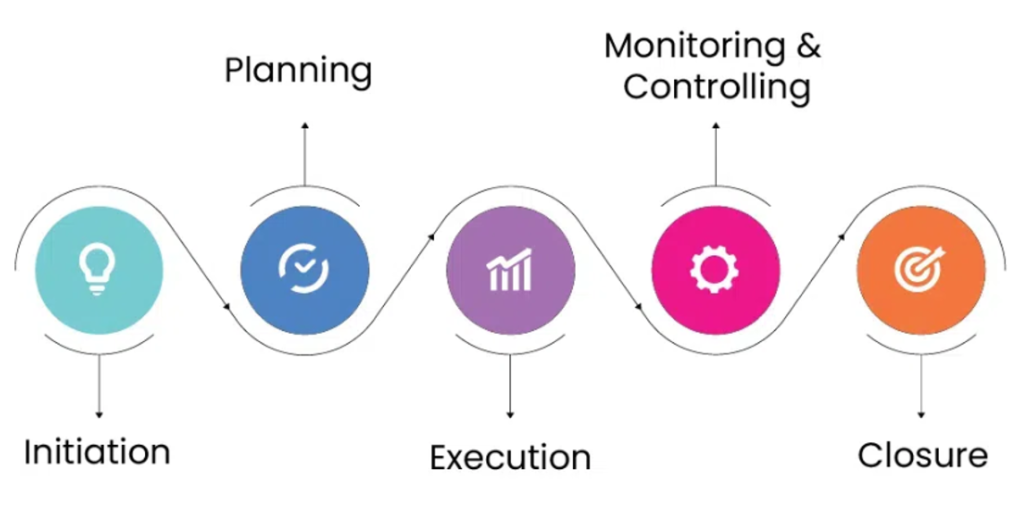
A project moves through stages. The project begins with an idea or concept then it passes through various steps such as planning, appraisal, decision making, implementation, monitoring, completion and final evaluation.
Thus, Project Cycle or Project Life Cycle refers to the series of stages that a project passes through from start to its completion and final evaluation. It helps in managing and structuring the project effectively.
1. Project Initiation
It is the first stage in project life cycle, where the objectives, scope and stakeholders of the project are defined. A business case is created to assess costs and benefits, while a statement of work outlines objectives and deliverables (outcomes). Key activities include defining the project, analyzing stakeholders, and assessing feasibility.
Example: For a construction project of a new bridge, the initiation phase would involve conducting a feasibility study, defining the purpose of the bridge (such as reducing traffic congestion), and identifying key stakeholders (such as government agencies, contractors, and the local community).
2. Project Planning
This phase involves detailed planning for all aspects of the project, including:
- Scope: Defining the project’s objectives and deliverables.
- Estimating cost: Determining the financial resources needed.
- Scheduling: Developing a timeline for each task and overall project completion.
- Allocation of tasks and resources: Breaking down the project into specific tasks and assigning resources (e.g., labor, materials).
- Risk management: Identifying potential risks and developing strategies to mitigate them.
Example: For the bridge construction project, the planning phase would include creating blueprints for the bridge design, selecting construction materials, estimating the budget, setting timelines for completion, and establishing risk management strategies.
3. Project Execution
In this phase, the work is actually carried out according to the project plan. The project team performs tasks and activities to achieve the project’s deliverables. This phase consumes the most resources and energy. Constant and close monitoring of the work is done to ensure efficiency of the project execution.
Example: For the bridge construction, the execution phase involves actual construction activities such as building the bridge foundation, pillars and roadbed.
4. Project Monitoring and Evaluation
This phase runs simultaneously with the execution phase and involves tracking the project’s progress. Monitoring and controlling ensure that the project stays within its scope, budget, and timeline.
Example: During the bridge construction, monitoring and controlling would include regular inspections, progress reporting, tracking construction costs, and ensuring the safety regulations.
5. Project Closure
The closing phase marks the completion of the project. It involves finalizing all project activities, delivering the project to the client, closing contracts, and performing a final review to assess if all objectives were met.
Example: For the bridge construction project, the closing phase would include completing all construction tasks, inspecting the bridge for any defects, handing over the completed bridge to the relevant authorities, finalizing payments with contractors.

2 Responses