
What is Capital Budgeting?
Capital Budgeting is the process of evaluating and selecting long-term investment projects that involve significant capital expenditures such as purchasing new machinery, expanding production facilities, or launching new products. It compares costs and benefits of projects to determine its long-term profitability.
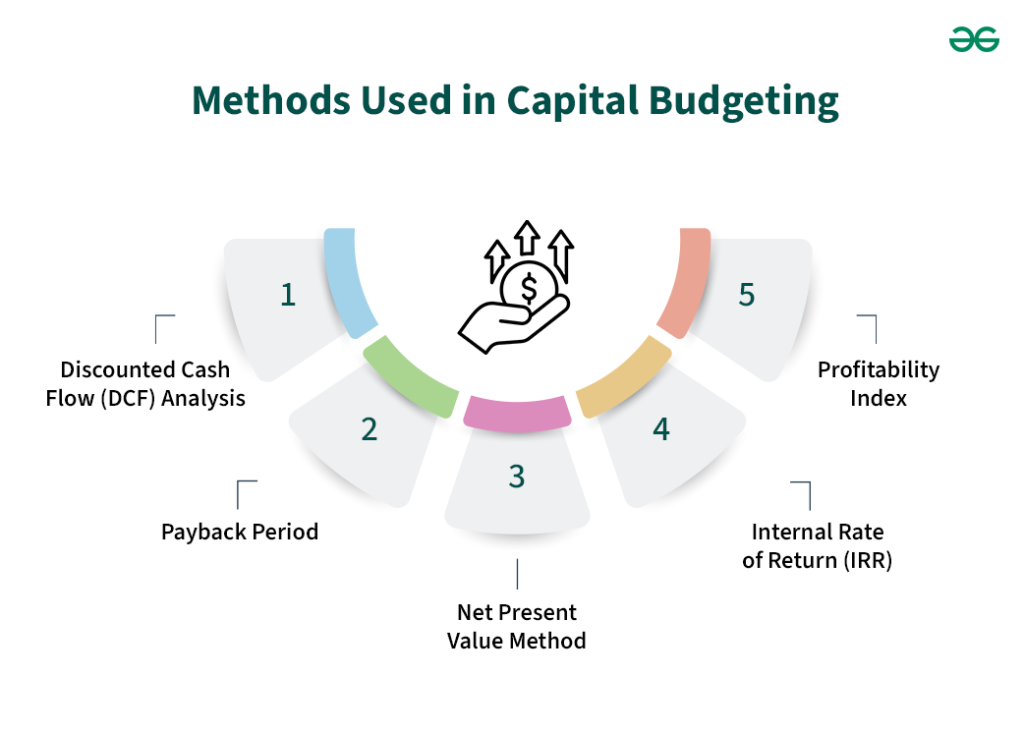
Some of the most common capital budgeting techniques are net present value, internal rate of return, payback period, profitability index etc.
Capital Budgeting Techniques
Capital budgeting techniques are the methods used to determine the long-term profitability of investment projects. These methods are divided into two broad categories.
- Discounted cash flow
- Undiscounted cash flow
Discounted Cash Flow (DCF)
Discounted Cash Flow (DCF) methods consider the time value of money (TVM), which recognizes that money today is worth more than the same amount in the future due to its earnings potential. These methods include
- Net Present Value (NPV)
- Internal Rate of Return (IRR)
- Profitability Index (PI)
Net Present Value (NPV)
NPV is the difference between present value of all future cash inflows and initial cash outflow (C_0). NPV uses discount rate (r) to convert future value in the present value.

- If NPV > 0, accept the project.
- If NPV < 0, reject the project.
- If NPV = 0, the project is neither profitable nor loss-making.
A Numerical Example of NPV
Problem
A sum of USD 400,000 dollars invested today in an IT project may give a series of below cash inflows in future:
- USD 70,000 in year 1
- USD 120,000 in year 2
- USD 140,000 in year 3
- USD 140,000 in year 4
- USD 40,000 in year 5
If the opportunity cost of capital is 8% per annum, then should we accept or reject the project?
Solution
Step 1: Calculate the PV value of year 1, year 2, year 3, year 4, and year 5.
Step 2: Sum up the PV of all years.
Step 3: NPV = Present value of all cash inflows – Present value of all cash outflows.
Step 4: If NPV is positive, accept the project; if not, reject the project.
Formula for calculating Present Value:

| Year | Formula | Calculation | Result |
|---|---|---|---|
| Year 1 | PV1 = 70000 / (1.08)1 | 70000 / 1.08 | 64,814.8 |
| Year 2 | PV2 = 120000 / (1.08)2 | 120000 / 1.17 | 102,880.7 |
| Year 3 | PV3 = 140000 / (1.08)3 | 140000 / 1.26 | 111,136.5 |
| Year 4 | PV4 = 140000 / (1.08)4 | 140000 / 1.47 | 102,904.2 |
| Year 5 | PV5 = 40000 / (1.08)5 | 40000 / 1.59 | 27,223.3 |
| Total Cash Inflow (PV) | 408,959.5 | ||
Cash Inflow of all Present Values: USD 408,959
Present Value of Cash Outflow: USD 400,000

Since NPV is positive (i.e. USD 8959). This project can be accepted.
Internal Rate of Return (IRR)
IRR is the discount rate that makes the NPV of a project equal to zero. It represents the project’s expected rate of return. The project with higher IRR is desirable.
- If IRR > discount rate, accept the project
- If IRR < discount rate, reject the project.
- If IRR = discount rate, may or may not accept the project.
Relationship between IRR, Discount rate and NPV
- If IRR > Discount rate; The NPV is always Positive.
- If IRR < Discount rate; The NPV is always Negative.
- If IRR = Discount rate; The NPV is Zero.
Profitability Index (PI)
Profitability Index is the ratio of present value of all future cash inflows to Initial cash outflows. It tells for every dollar spent; how much are we getting back. Higher the profitability Index of the project, the better.

- Accept the project when PI > 1
- Reject the project when PI < 1
- May or may not accept the project when PI = 1
A Numerical Example of PI
A sum of USD 25,000 invested today in a project may give a series of cash inflows in future as described below:
- USD 5000 in year 1
- USD 9000 in year 2
- USD 10,000 in year 3
- USD 10,000 in year 4
- USD 3000 in year 5
If the required rate of return is 12%, what is the Profitability Index? Profitability Index is 1.07. Since the PI>1 we accept the project.
Merits and Demerits of DCF Methods
Merits
- Considers Time Value of Money
- Useful for Comparing and ranking of Projects
- Considers All Cash Flows
- Discount rates can be adjusted to reflect risk.
Demerits
- Involves Complex Calculations such as calculating IRR
- Small changes in Discount Rate can alter the results
Non-Discounted Cash Flow (NDCF)
In Non-Discounted Cash Flow (NDCF) the interest in not taken into account and time value of money is not considered. Some of undiscounted methods are:
- Payback Period (PP)
- Accounting Rate of Return (ARR)
Payback Period (PBP)
Payback period is the number of years required to recover the initial cash outflow invested in the project. Projects with lower payback period are preferred.
Formula for Payback period
Case 1: When Annual Cash Inflows are Equal

Case 2: When Annual Cash Inflows are Unequal

A Numerical Example of PBP
Problem
A sum of USD 25,000 invested today in an IT project, may give a series of cash inflows in future as described below.
- USD 5,000 in year 1
- USD 9,000 in year 2
- USD 10,000 in each of year 3
- USD 10,000 in each of year 4
- USD 3,000 in year 5
What is the Payback Period (Non-discounted)?
Solution:
Initial Cash Outlay = USD 25,000
Cumulative Non-discounted Cash Inflow in USD dollars
- End of Year 1: 5,000
- End of Year 2: 14,000
- End of Year 3: 24,000
- End of Year 4: 34,000
- Last year before recovery=3
- Remaining investment=25000-24000=1000
- Cash inflow of recovery year=10,000

Payback Period = 3 years 1 month (approx.)
Accounting Rate of Return (ARR)
Accounting rate of return is the ratio of average annual accounting profit to initial investment.

- If ARR > required return, accept the project.
- If ARR < required return, reject the project.
Merits and Demerits of NDCF Methods
Merits
- Simple and easy to calculate
- Quick decision-making
- Suitable for short term investments
Demerits
- Ignores time value of money
- Does not consider all cash flows
- Not Suitable for Long-Term Projects
Few Tips to Remember
✔ Always choose projects with highest NPV.
✔ If NPV is same for the given projects, choose the project with highest IRR.
✔ If NPV, IRR remains the same for the given projects, choose the projects with early pay back period.
✔ NPV = All Cash Inflows – Cash Outflows
✔ PI = All Cash Inflows / Cash Outflows
✔ IRR = Discount rate at which the NPV becomes zero, this tell us what the percent of return for the project is.
✔ Payback period is a major consideration for every project, business or organization, it tells us how soon we can recover our investment, and this investment can be utilized for other business needs/projects later on.
Suggestions for Further readings:
