
Category: Blog

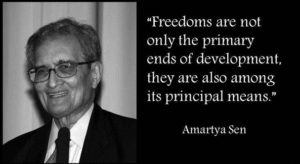
Sen Capability Approach

Core Values of Development Sustenance: Sustenance is the ability to meet life-sustaining basic needs like food, clothing, shelter, health, and protection. It is the minimum level required for a good life. If any of these basic needs are absent or shorter in supply, the situation is known as absolute underdevelopment.

Read More »

Variance and Standard Error of OLS Estimators and Gauss-Markov Theorem

In the previous article, Assumptions of Classical Linear Regression Model (CLRM), we discussed the assumptions of CLRM. In this article, we discuss the variance and standard error of OLS estimators and the Gauss-Markov Theorem. It has been shown in the post Simple Linear Regression Model that the OLS estimates are

Read More »
Assumptions of Classical Linear Regression Model (CLRM)
Econometrics
Muhammad Minhaj Akhtar

Assumptions of Classical Linear Regression Model (CLRM)

In the previous post, we discussed how to estimate a sample regression model, i.e., and . by applying the OLS method on sample data, both in simple and multiple linear regression models. You can read these posts here: A Numerical Example of Multiple Linear Regression by Hand and Simple Linear Regression

Read More »

Regression Through Origin

Introduction of Regression Through Origin Models So far we have studied models like Where intercept is present. An economic example of these models is the Keynes consumption function written as: Where  is autonomous consumption i.e., level of consumption when income is zero. In some cases, we wish to impose the

Read More »
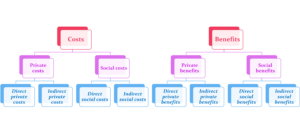
Costs and Benefits of Education
Development Economics
Muhammad Minhaj Akhtar

Education and Economic Development

Health, Education, and Economic Development Health and Education as Objectives of Development Education and health are basic objectives of development; they are important ends in themselves. Health is central to wellbeing, and education is essential for a satisfying and rewarding life. Health and Education as Inputs of Development At the

Read More »

Short Questions Project Appraisal

Short Questions Cash flow refers to the movement of money into and out of a business, project, or individual account over a specific period. For example, Revenue from sales of goods or services, loan repayments, interest payments, etc. Cash inflow is the amount of money coming into the business from

Read More »
Capital Budgeting
Project Appraisal
Muhammad Minhaj Akhtar

Capital Budgeting

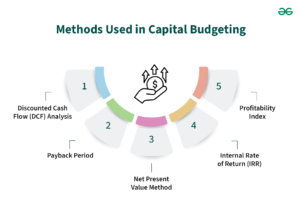
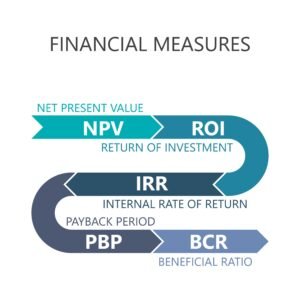
What is Capital Budgeting? Capital Budgeting is the process of evaluating and selecting long-term investment projects that involve significant capital expenditures such as purchasing new machinery, expanding production facilities, or launching new products. It compares costs and benefits of projects to determine its long-term profitability. Some of the most common

Read More »
Cost Benefit Analysis
Project Appraisal
Muhammad Minhaj Akhtar

Cost Benefit Analysis

What is Cost Benefit Analysis (CBA)? Cost Benefit Analysis (CBA) is a process that’s used to determine the profitability of a project by estimating and comparing its costs and benefits measured in monetary terms after adjusting for the time value of money. Objectives of Cost Benefit Analysis To determine the

Read More »

Long Questions Project Appraisal

LQ1 – Define project life cycle. Explain different stages of project lifecycle in detail. Project Project is an interrelated set of activities undertaken to achieve a specific objective. It is unique and temporary in nature with a defined beginning and end. Examples, bridge construction project, developing a new product, building

Read More »

Econometrics-I Short Questions

Econometrics: Literally, the word econometrics means economic measurement or the measurement of economic relationships. According to Goldberger: Econometrics may be defined as the social science in which the tools of economic theory, mathematics and statistical inference are applied to the analysis of economic phenomena. Uses/functions/objectives of econometrics: Testing economic theories and models Estimating numerical values

Read More »

Development Economics Short Questions

Short Questions Absolute poverty is the situation of being unable or only barely able to meet the basic needs of life such as food, clothing, shelter, and basic health care. According to World Bank, nowadays global poverty line is 3 USD per person per day. Absolute poverty line is used

Read More »

Principles of Macroeconomics Short Questions

Short Questions Consumption is that part of disposable Income which is spent on consumer goods and services. The relationship between consumption and income is represented by consumption function written as C=f(Y). The slope of this function is called MPC. Saving is that part of disposable income that is not consumed.

Read More »

Principles of Microeconomics Long Questions

LQ.1. Explain the law of diminishing utility. Illustrate your answer with appropriate diagrams. Discuss also the assumptions and limitations of this law. Law of Diminishing Marginal utility (Gossen’s First Law) “The Law of Diminishing Marginal Utility states that as a consumer consumes more and more units of a good, then

Read More »

Development Economics Long Questions

LQ 1; Define development economics. What is the scope/significance of development economics. What is Development Economics? Development economics is the subfield of economics which studies how economies are transformed from stagnation to growth and from low income to high income status and overcome the problem of extreme poverty. Why a

Read More »

Principles of Macroeconomics Long Question

LQ 1: Define Macroeconomics. Discuss its scope, importance and limitations. Macroeconomics Macroeconomics deals with the behavior and performance of the economy as a whole. It studies aggregate economic activities such as aggregate output, aggregate demand, national income, aggregate price level, employment level, international trade, business cycles etc. Scope of Macroeconomics

Read More »