
Classical Theories of Economic Development
- Linear Stage Models
- Rostow Stages of Economic Development
- Harrod-Domar Growth Model
- Structural Change Models
- Lewis Model of Economic Development
- Fei-Ranis Two-Sector Model
- International Dependence Model
- Neocolonial Dependence Model
- The False-paradigm Model
- The Dualistic-development Thesis
- Neoclassical Growth Model
- Solow Growth Model
Introduction
International dependence models gained popularity in 1970`s when developing countries were disappointed from stages and structural change models. The dependency theories divide the whole world into two set of countries. The Global North and the Global South.
Generally, the global north countries like Western Europe, Britain and the United States are developed countries (DCs) and global south such as Asia, Africa and Latin America are Least Developed Countries (LDCs).
The DCs are also called the centre and the LDCs are also called periphery. There are unequal centre-periphery relationships whereby LDCs are dependent on DCs in trade, foreign aid, investment and technology, etc.
Dependence
Dependence means reliance of developing countries on developed-country economic policies to stimulate their own economic growth. Dependence can also mean that the developing countries adopt developed countries education systems, technology, economic and political systems, attitudes, consumption patterns, dress, and so on.
Dominance
In international affairs dominance means a situation in which developed countries have much greater power than less developed countries in international issues and decisions such as the prices of agricultural commodities and raw materials in world markets.
International Dependence Model
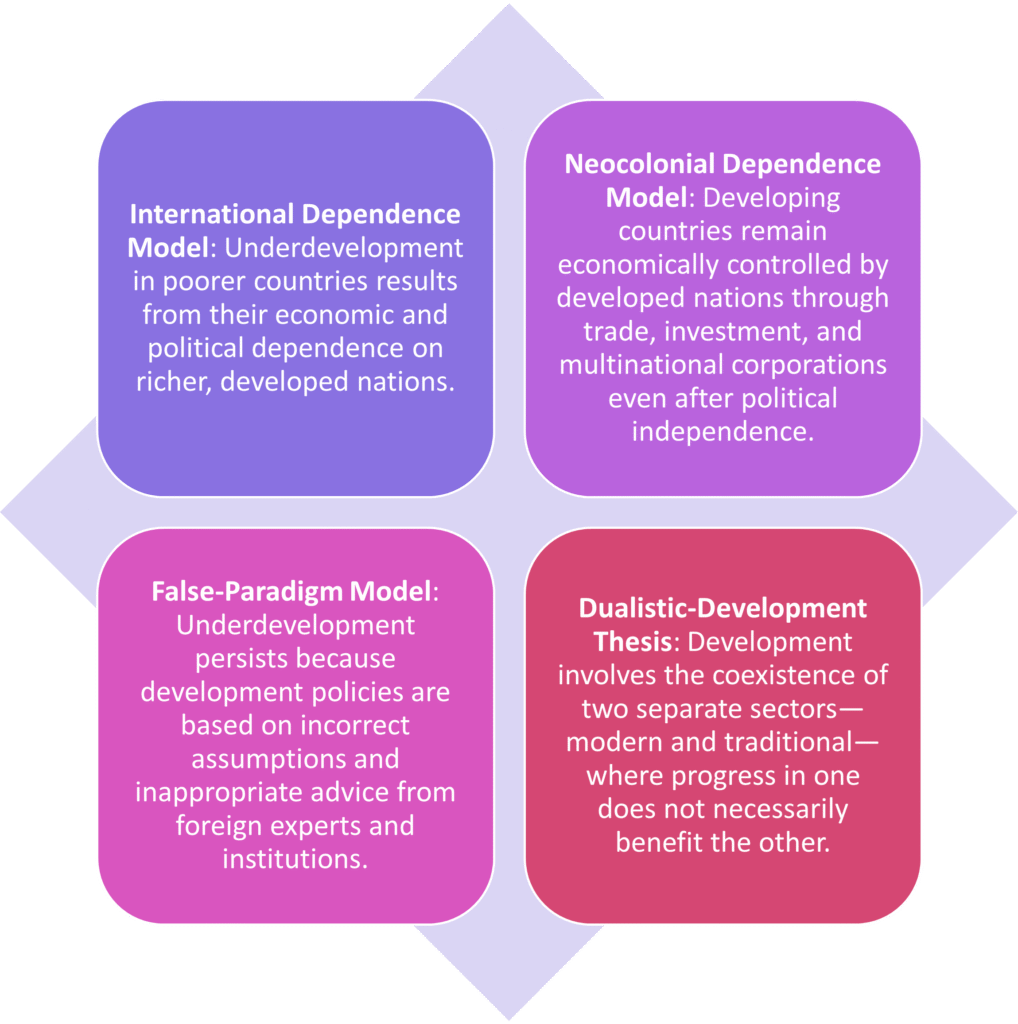
International dependence models view developing countries as being trapped in a cycle of dependence and dominance, primarily due to historical and ongoing inequalities in the global economic system.
In this general approach there are three major streams of thought:
- The neocolonial dependence model
- The false-paradigm model
- The dualistic-development thesis
The Neocolonial Dependence Model
Most of the developing and underdeveloped counties were once the colonies of the Great-Britain and other European countries like Subcontinent India, and most of the African countries. Although these countries have gained independence from these colonials but still these countries adopt the policies of colonials. Thus, Neocolonial dependence model states that underdevelopment exists in developing countries because of continuing exploitative economic, political, and cultural policies of former colonial rulers toward less-developed countries.
In developing countries, a small group of powerful people, like government officials, business leaders, landlords and military rulers collaborate with international organizations such as MNCs, the World Bank, and the IMF. They grow richer by supporting the interests of wealthy nations for which they are rewarded while most of the population stays poor.
The False-Paradigm Model
The false-paradigm model states that developing countries have failed to develop because their development strategies and policies are often designed by Western economists and international agencies. These strategies are unsuitable for developing countries because they overemphasize capital accumulation or liberalization while neglecting the social, institutional, and cultural factors essential for development.
In addition, the economists and civil servants in developing countries are trained in Western universities in which they are taught irrelevant Western concepts and models such as how to measure capital-output ration, increase in savings and investment ratios, privatization etc. due to which they have little or no knowledge about real development problems.
The Dualistic-Development Thesis
Dualistic development thesis suggests that developing countries are divided into two opposite situations simultaneously in which one is desirable and other is not. For example, extreme poverty and affluence, modern and traditional economic sectors, growth and stagnation, higher education to few and illiteracy at large.
It embraces four key arguments.
- Different sets of conditions coexist one is superior and other is inferior such as of Lewis model in which economy is divided into traditional, rural agriculture sector and modern urban manufacturing sector.
- This coexistence is chronic (last for long period of time and it is not temporary.
- The degree of superiority and inferiority increases overtime such as the productivity gap between workers of developed and developing countries widens.
- The existence of superior element does not pull up the inferior element rather push it down to “develop its underdevelopment.
Some Concepts
- Underdevelopment is an economic situation characterized by low level of living, low per capita income, absolute poverty, poor health services, high death rates, high birth rates, dependence on foreign economies and limited economic and social freedom to satisfy human wants.
- Dualism is the coexistence of two situations from which one desirable and the other not that are mutually exclusive—for example, extreme poverty and prosperity, modern and traditional economic sectors, growth and stagnation, and higher education for a few and large-scale illiteracy.
Suggestions for further reading:

One Response