
Introduction
Welcome to the fascinating world of econometrics! Studying econometrics bridges the gap between being a student of economics and becoming a practicing economist. It equips you with essential tools for analyzing economic data, empirically testing economic theories, providing numerical estimates of economic relationships, and forecasting future events.
In this introductory post, we will delve into the foundational aspects of econometrics, including its definition, objectives, and the distinctions between econometrics and other related fields.
Origin of Econometrics
The term econometrics is derived from two Greek words: oikonomia (economics) and metron (measurement). Literally, the word econometrics means economic measurement or the measurement of economic relationships. Ragnar Frisch, who coined the term econometrics, is one of the founders of the Econometric Society (Christ, 1983). ‘Econometrics aims at giving empirical content to economic relationships’. The three key ingredients are: Economic theory, Economic data, and Statistical methods.
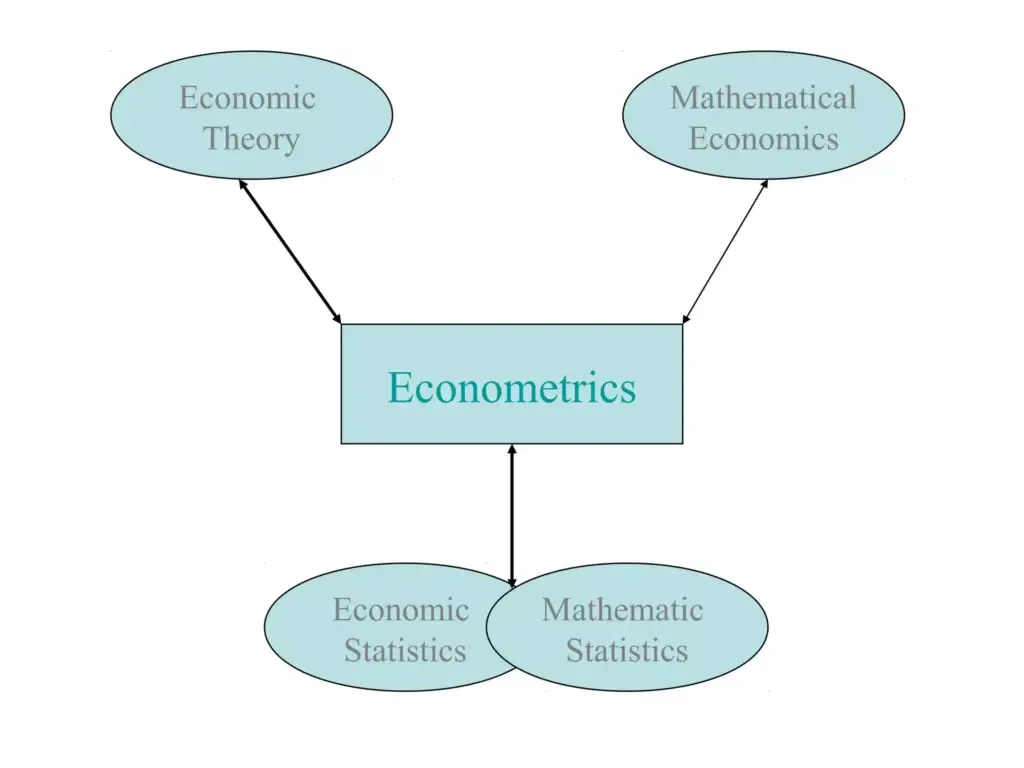
Neither theory without measurement, nor measurement without theory, is sufficient for explaining economic phenomena. An econometrician is an individual who is both an economist by training and a competent mathematician and statistician. Therefore, a fundamental knowledge of mathematics, statistics, and economic theory is a necessary prerequisite for this field. Ragnar Frisch (1933) explains in the first issue of Econometrica that it is the unification of statistics, economic theory, and mathematics that constitutes econometrics (Baltagi, 2022).
Ragnar Frisch, a Norwegian economist, shared the first Nobel Prize in Economics with Jan Tinbergen, a Dutch economist, for their work in econometrics in 1969. Frisch and Tinbergen are considered the founding fathers of econometrics. Lawrence R. Klein, the 1980 recipient of the Nobel Prize in Economics “for the creation of econometric models and their application to the analysis of economic fluctuations and economic policies,” has always emphasized the integration of economic theory, statistical methods, and practical economics.
Definitions of Econometrics
As far as we concern about the definition of econometrics, there is no one definition of econometrics, ask a half dozen econometricians what econometrics is, and you could get a half dozen different answers. One might tell you that econometrics is the science of testing economic theories. While others say:
- Econometrics is based upon the development of statistical methods for estimating economic relationships, testing economic theories, and evaluating and implementing government and business policy. (Wooldridge, 2019)
- Econometrics is defined as the social science in which the tools of economic theory, mathematics, and statistical inference are applied to the analysis of economic phenomena. (Goldberger, 1964)
- Econometrics is the integration of economics, mathematics, and statistics for the purpose of providing numerical values for the parameters of economic relationships (elasticities, propensities, and marginal values) and verifying economic theories. (Koutsoyiannis, 1977)
- Econometrics is the application of statistical and mathematical methods to the analysis of economic data, with a purpose of giving empirical content to economic theory and verifying or refuting them. (Maddala, 2001)
- Econometrics is the integration of economic theory, mathematics, and statistical techniques for the purpose of testing hypotheses about economic phenomena, estimating coefficients of economic relationships, and forecasting or predicting future values of economic variables or phenomena. (Salvatore & Reagle, 2002)
Uses/Objectives/Purpose of Econometrics
- Testing economic theories and models
- Estimating numerical values of economic coefficients
- Forecasting future events
- Evaluating programs and policies
- Identifying cause and effect relationships
Econometrics vs Other Fields
Economic Theory vs Econometrics
Economic theory makes statements or hypotheses that are mostly qualitative in nature. For example, microeconomic theory states that, other things remain the same, a reduction in the price of a commodity is expected to increase the quantity demanded of that commodity. Thus, economic theory postulates a negative or inverse relationship between the price and quantity demanded of a commodity. But the theory itself does not provide any numerical measure of the relationship between the two; that is, it does not tell by how much the quantity will go up or down as a result of a certain change in the price of the commodity. It is the job of the econometrician to provide such numerical estimates.
Mathematical Economics vs Econometrics
Mathematical economics concerns expressing economic theory in mathematical form (equations) without regard to measurability or empirical verification of the theory. It expresses the economic relationship in exact or deterministic form. Whereas econometricians empirically test economic theory or hypothesis and provides estimated values to economic relationships.
Economic Statistics vs Econometrics
Economic statistics is mainly concerned with collecting, processing, and presenting economic data in the form of charts and tables. These are the jobs of the economic statistician. It is he or she who is primarily responsible for collecting data on gross national product (GNP), employment, unemployment, prices, and so on. The data thus collected constitute the raw data for econometric work. To know different types of datasets collected by economic statisticians click on Understanding Types of Economic Data with Real Examples.
But the economic statistician does not go any further, not being concerned with using the collected data to test economic theories. Of course, one who does that becomes an econometrician. Statistical methods describe the measurement which are developed on the basis of controlled experiments. But these methods do not fit to explain economic phenomenon. Moreover, most of the statistics is concerned with the statistical inference i.e., inference about population based on sample. Whereas econometricians are interested in casual inference i.e. finding cause and effect relationships.
Mathematical Statistics vs Econometrics
Mathematical statistics provide many estimation tools, but these tools cannot be directly applied to econometrics because of the unique nature of economic data. Economic data is often observational rather than experimental. The econometrician, like the meteorologist, generally depends on observational data that cannot be controlled directly. Thus, econometrics require separate tools of analysis. As Jeffrey M. Wooldridge put “naturally, econometricians have borrowed from mathematical statisticians whenever possible. In addition, economists have devised new techniques to deal with the complexities of economic data and to test the predictions of economic theories”.
Types of Econometrics
Theoretical Econometrics
It is concerned with the development of appropriate methods for measuring economic relationships specified by econometric models. It heavily relies on probability theory and statistics. It does not apply these methods to real data to test theory or hypothesis. It is focused on:
- How and why econometric techniques work
- Properties of estimators (bias, consistency, efficiency)
- Hypothesis testing theory
- Asymptotic behavior (large sample properties)
- Identification problems
- Model specification issues
It answers questions like:
- Is OLS unbiased?
- Under what conditions is an estimator consistent?
- What happens when assumptions fail?
Applied Econometrics
It uses the tools of theoretical econometrics to study some special field(s) of economics and business, such as the production function, investment function, demand and supply functions, portfolio theory, etc. It is used to:
- Estimate economic relationships
- Testing economic theory or hypothesis
- Forecasting economic variables
- Evaluating public policies and programs
It answers questions like:
- Does education increase wages?
- What is the impact of tax on consumption?
- Did a policy reduce poverty?
- Does green finance help improve environmental quality?
Mathematical Econometrics
It applies advanced mathematics to formally derive econometric models and results. It expresses econometric relationships in rigorous mathematical form. It heavily relies on linear algebra, probability theory, optimization techniques to derive various mathematical formulas for various techniques. For example, it is used to derive the OLS estimator using matrix algebra.
Conclusion
From all the above discussions we conclude that econometrics is different from qualitative economics because it frequently uses no mathematics. It is distinguished from mathematical economics which is quantitative but not empirical and uses no statistics. Finally, it is different from theoretical work in statistics which uses mathematics but is in general unrelated to economics. Thus, econometrics is the unification of mathematics, statistics, and economics. (Tintner, 1953, p. 37).
Suggestions for further readings

2 Responses
Hi, this is a comment.
To get started with moderating, editing, and deleting comments, please visit the Comments screen in the dashboard.
Commenter avatars come from Gravatar.