

Classical Theories of Economic Development
- Linear Stage Models
- Rostow Stages of Economic Growth
- Harrod-Domar Growth Model
- Structural Change Models
- Lewis Two-Sector Model
- Fei-Ranis Two-Sector Model
- International Dependence Model
- Neocolonial Dependence Model
- The False-paradigm Model
- The Dualistic-development Thesis
- Neoclassical Growth Model
- Solow Growth Model
In the couple of previous blogs we discussed the linear stages models including Rostow Stages of Growth and Harrod-Domar Growth Model. In this blog we will discuss the structural change models like Lewis Model of Economic Development. We begin with the concept of structural change.
Structural Change
When some sectors in an economy expand while others shrink, we refer it as structural change. In the context of economic development, structural change refers to the shift from agriculture economy that relies on traditional farming methods to urban economy that relies on modern industrial technologies.
Today`s advanced economies underwent this process between 18th and 20th century, while many Asian economies such as China, are going through it. Another structural change occurs when economies transform from industrial sector to services sector which includes all non-industrial urban sectors such as banking, insurance, health, education, entertainment, hotels etc.
Structural Change Theory
Structural-change theory explains how underdeveloped economies shift from reliance on agriculture sector to becoming more urbanized, modern, industrial and service sectors. Structural Change models focuses on the shift of underdeveloped economies from traditional agricultural production to more advanced industrial economies. These models explain the reasons and the process by which underdeveloped economies transform and shift their reliance from rural subsistence agriculture to urban or modern industrial production.
The process of transforming an economy in such a way that the contribution of manufacturing sector in national income surpasses the contribution by the agricultural sector is called structural transformation.
Lewis Model of Structural Change
Nobel Laureate W. Arthur Lewis, in an article “Theory of Economic Development with Unlimited Supplies of Labour” in 1954 formulated a theory known as the Lewis theory of Economic Development. This model was later modified, formalized, and extended by John Fei and Gustav Ranis.
The Lewis model of structural change focused on the structural transformation of a subsistence agricultural economy with surplus labor to an advanced industrial economy through shifting surplus labor to the modern sector. It is also known as Lewis` two-sector model.
In the Lewis model, the underdeveloped economy consists of two sectors.
- Traditional sector (agriculture), overpopulated, rural subsistence sector characterized by zero marginal labour productivity.
- Modern sector (industrial), high-productivity modern, urban industrial sector.
Lewis two-sector model states that in underdeveloped countries there is always surplus labor in agricultural sector, thus if we withdraw this surplus labor from agriculture sector and employ in the industrial sector, this will bring industrialization and sustained development. By surplus labor Lewis means the labor whose marginal productivity is zero or negative.
Thus, Lewis model focuses on two things
- Labor transfer
- Modern sector employment growth
The rate with which the employment and output grow in modern sector depends on the rate of industrial investment and capital accumulation in the modern sector.
Assumptions of the Model
- Surplus labor in agriculture: It implies that more people are willing to supply their labor then needed, thus adding an extra labor does not increase agri. output. So, MPL is zero.
- Wage rate is determined by APL in agriculture sector as all workers contribution to total output is equal.
- Capitalists reinvest all their profit.
- Wages in the modern sector are constant and higher than subsistence wage.
- Supply curve of rural labor to the modern sector is perfectly elastic.
Explanation of Lewis Model Through Diagram
Diagram
Explanation
Agriculture Sector
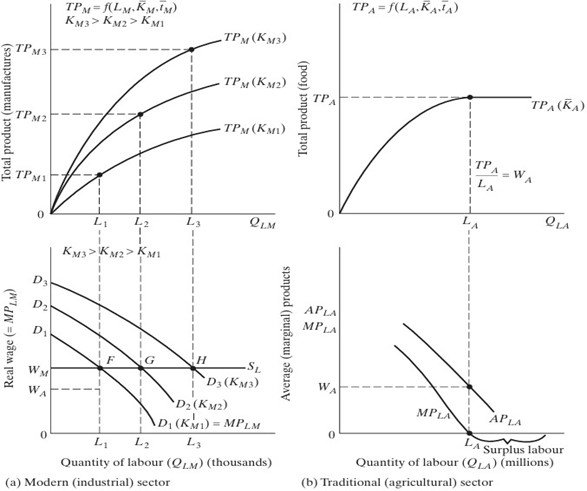
- The right-hand side of the figure shows agricultural sector output. Upper right-hand side shows agriculture production function and lower right-hand side shows MP and AP of labor.
- Lewis makes two assumptions (i) There is surplus labor in agriculture sector (ii) all workers share equally in output; thus, wage rate is determined AP of labor in agriculture sector.
- Labor beyond LA is considered surplus because there is no increase in output after that level of labor thus, MP of labor becomes zero, or even negative.
- If we withdraw this surplus labor from agriculture sector and transferred to modern sector there will be no effect on agricultural output.
- WA shows subsistence wage rate in the agriculture sector. It is determined by the AP of labor.
Industrial Sector
- The left hand-side shows modern sector output. The upper left hand-side shows manufacturing sector production function and lower left hand-side shows MP of labor.
- In the Lewis model, the modern-sector capital stock increases as a result of the reinvestment of profits by industrial capitalists. Thus, aggregate production function in this sector shifts upward.
- The lower left hand-side shows MP of modern sector labor.
- Lewis assumes that real wage rate in modern sector is constant and above than subsistence wage rate in agriculture sector.
- This wage rate is shown by WM SL. This curve is also the rural supply of labor curve which is perfectly elastic.
- This shows that modern-sector employers can hire as many surplus rural workers as they want without fear of rising wages.
- Modern sector demand for labor is determined by MP of labor curve. At initial stages modern sector firm demand L1 amount of labor and produces TPM1 amount of output with given capital.
- The total wages that modern sector firm pay to workers is OWMFL1 and profit is WM D1F.
- This profit will be reinvested which will increase the capital stock and thus shifts production function of modern sector upward and also the demand for labor curve.
- It will increase total wages, labor amount, total output and profits which will be reinvested.
Lewis Turning Point
- Lewis model predicts that the process of increasing output and employment will continue until all rural surplus labor is absorbed in modern sector.
- Therefore, a point comes when additional workers can be withdrawn from the agricultural sector only at a higher cost of lost food production because the declining labour-to-land ratio means that the marginal product of rural labour is no longer zero. This is known as the “Lewis turning point.” Thus, the labour supply curve becomes positively sloped.
- Lewis turning point occurs when rural labor supply curve becomes positive and wages in urban modern sector start to rise due to continuous growth in output and employment in urban modern sector.
Criticism of Lewis Model
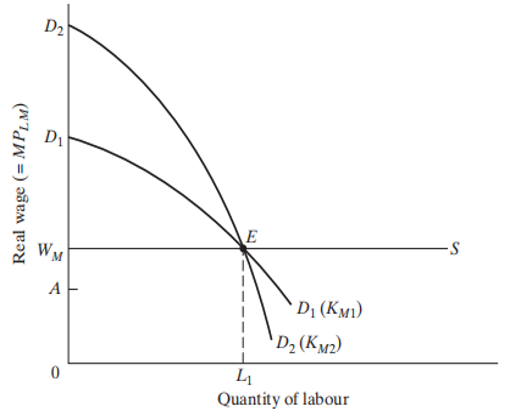
- First, the model implicitly assumes that the rate of labour transfer and employment creation in the modern sector is proportional to the rate of modern-sector capital accumulation.
- But what if capitalist profits are reinvested in more sophisticated labor-saving capital equipment.
- Demand curve D2(KM2) has a greater negative slope than D2(KM1) to reflect the fact that additions to the capital stock embody labor-saving technical progress—that is, KM2 technology requires much less labour per unit of output than KM1 technology does.
- The second questionable assumption of the Lewis model is the notion that surplus labour exists in rural areas while there is full employment in the urban areas. Most contemporary research indicates that there is little surplus labour in rural locations.
- Third assumption is constant wages in urban sector. Prior to the 1980s all developing countries was the tendency for these wages to rise substantially over time.
- The fourth concern with the Lewis model is its assumption of diminishing returns in the modern industrial sector. Yet there is much evidence that increasing returns prevail in that sector.
- Fifth concern is that this model disregard the human capital such as education, skill and health.
Application of the Lewis Model
The model is widely considered relevant to recent experiences in China, where labour has been steadily absorbed from farming into manufacturing, and to a few other countries with similar growth patterns. The Lewis turning point at which wages in manufacturing start to rise was widely identified with China’s wage increases starting in 2010 (see the case study for Chapter 4).
Some Concepts
- Surplus labour The excess supply of labour over and above the quantity demanded at the going free-market wage rate. In the Lewis two-sector model, surplus labour refers to the portion of the rural labour force whose marginal productivity is zero or negative.
- Production function A technological or engineering relationship between the total output and the quantity of inputs required to produce it.
- Average product Total output or product divided by total factor input (e.g., the average product of labour is equal to total output divided by the total amount of labour used to produce that output.
- Marginal product The increase in total output resulting from the use of one additional unit of a variable factor of production (such as labour or capital).
- Self-sustaining growth Economic growth that continues over the long term based on saving, investment, and complementary private and public activities.
- Industrialization refers to the process by which an economy transforms from primary agriculture sector to manufacturing of goods and services. It involves the development and expansion of industries such as factories, technology, and large-scale production.
References

3 Responses