
In the previous post we study about Demographic Transition Theory. In this post we will discuss
Introduction to Malthus Population Theory
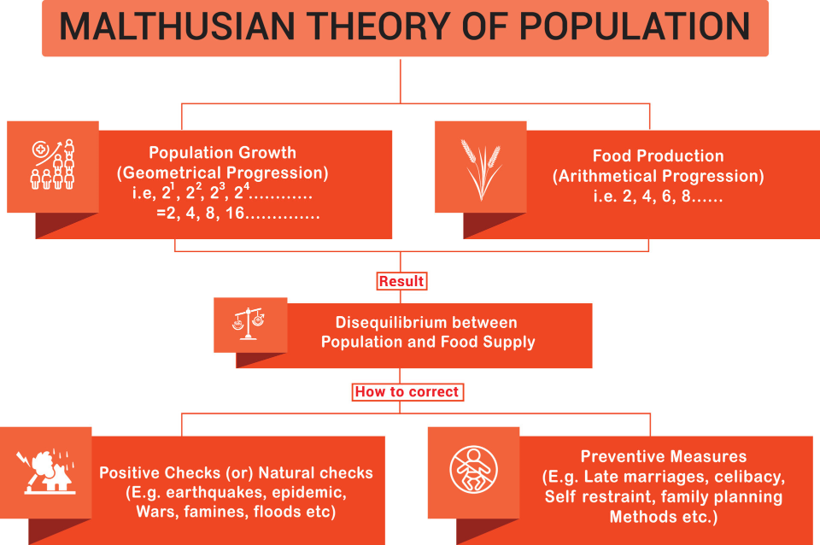
Thomas Malthus examined the relationship between population growth and food supply in his essay “The Principle of Population” in 1798. This theory has two core principles:
Core Principles of Malthusian Population Theory
Population Grows Exponentially
He postulated that any increase in living standards would result in an increase in population size. Malthus predicted that population, if left unchecked, increases in geometrical progression (1, 2, 4, 16, 32, etc.) and would double in every 25 years.
Food Supply Grows Arithmetically
But the food production increases very slowly due to the operation of the Law of Diminishing Marginal Returns in agriculture. It states that as we increase unit of land, food production increases at a decreasing rate since land fertility is limited. Thus, the food supply increases at arithmetic progression (like 1, 2, 3, 4, 5, 6, etc.). So, food supply increases much slower than population growth.
Imbalance between the Two
As a result, there will be a disequilibrium between population growth and food production which leads to overpopulation. This overpopulation causes decrease in food per capita or shortage of food over time which will continue until population growth is halted due to positive checks such as starvation, famine, war, diseases etc.
Subsistence Equilibrium
As a result of these positive checks on the growth of population, balance between population and food supply is restored. This would lead to increase food supply per capita, which again encourages population growth, which again leads to overpopulation and then positive checks are applied again. Thus, population remains revolving around the subsistence level of food or income. This is known as Malthusian trap explained in figure 1.
Explanation of Malthus Theory Through Diagram
Figure 1: Mathus Population Trap
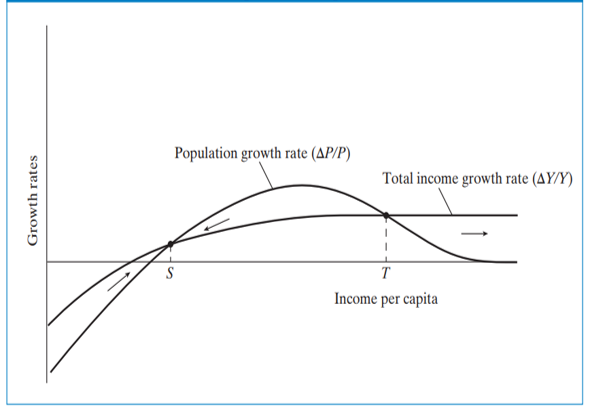
In figure 1 vertical axis measures population growth rate and income growth rate while the horizontal axis measures the level of income per-capita. Per capita income is the difference between income growth rate and population growth rate, the vertical difference between these two curves.
Income Per Capita=Income growth rate-Population growth rate
To the left of point S, at very low level of income population growth is also very low because low income means lower expenses on health and nutrition; therefore, population is influenced by fatal diseases and starvation.
Since income growth is greater than population growth rate thus per-capital income and population would increase, and the economy will move to the subsistence level of income per-capita.
To the right of point S, population growth rate is greater than income growth rate per-capital income and population growth would fall, and the economy again moves towards point S.
Point S is the subsistence level of income or food around which population growth revolves. To escape this level Malthus, suggest two types of checks.
How to avoid Malthus population trap
To avoid population trap Malthus proposed two types of checks: preventive checks and positive checks.
Positive Checks
Preventive checks are human-driven measures to limit population growth by reducing fertility rates. Such as delayed marriages, celibacy, family planning, contraception, women education and empowerment etc.
Preventive Checks
Positive checks are natural events that increase mortality rates such as famines, diseases, war, flood, earthquake. They reduce population when it exceeds the food supply.
Other measures
- Technological progress can help increase per capita income and food supply such as use of modern technology and HYV seeds which shifts the food production curve or income per capita curve upward.
- Cultural and institutional changes shift the population growth rate curve downward; this will also increase per-capita income.
How population trap works
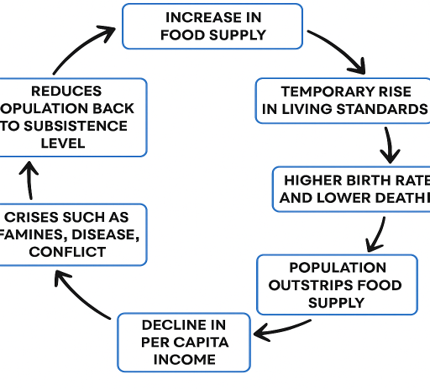
Increase in food supply → temporarily raises living standards → rapid population growth → population outstrips food supply→ per capita income declines → crises such as famines, disease, conflict begins→ reduces population back to subsistence level.
Criticism of Malthusian Theory
Technological Advancements: Malthus ignores the impact of technological advancement that can shift the aggregate income or food production growth curve upward and population growth curve downward.
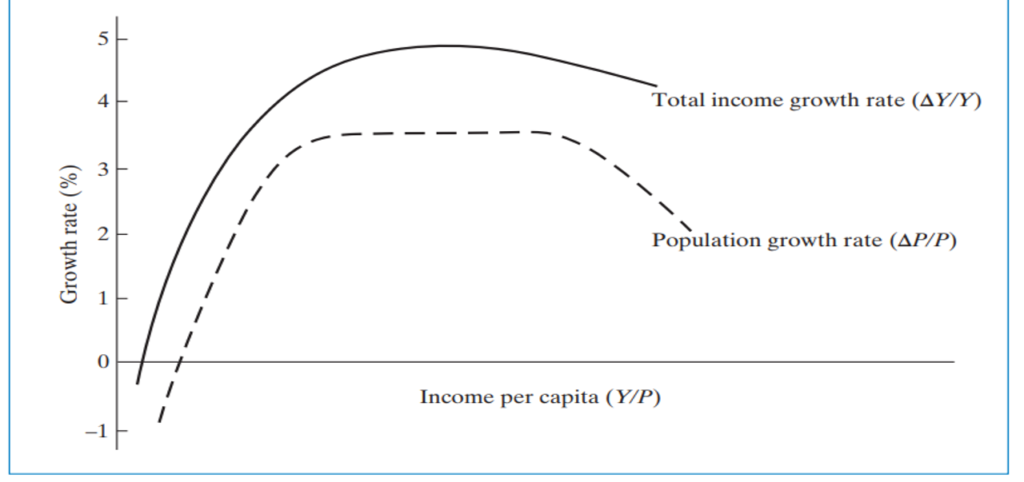
Correlation between population growth and per-capita income growth: Research shows no strong correlation at macro level between per capita income growth and population growth, rather the relationship exist at micro level between fertility rate and household income.
Growth of Income and Population: Malthus’s claim that population grows geometrically, and income arithmetically lacks historical evidence, as population growth has not followed geometric patterns.
Modern Relevance of Malthusian Theory
- Food Insecurity: Despite global improvements in food production, many regions still experience food shortages.
- Environmental Issues: Increasing population, urbanization, deforestation, burning fossil fuel are serious concerns which result in climate change and global warming affecting food production and human population.
- Pandemics and Health Crises: Events like COVID-19 remind us how population density can contribute to the rapid spread of diseases a form of “Malthusian check”.
Suggestions for Further readings

One Response