
LQ 1: Define Macroeconomics. Discuss its scope, importance and limitations.
Macroeconomics
Macroeconomics deals with the behavior and performance of the economy as a whole. It studies aggregate economic activities such as aggregate output, aggregate demand, national income, aggregate price level, employment level, international trade, business cycles etc.
Scope of Macroeconomics
The scope of macroeconomics refers to the areas covered by it. These areas include various theories such as:
Theory of National Income
Macroeconomics studies concepts, components, methods, and difficulties of measuring national income. These estimates are used to compare economic performance over time and across countries.
Theory of Income and Employment
It explains the determination of national income and employment using AD–AS and IS–LM models. It includes Classical and Keynesian theories and examines causes and effects of unemployment.
Theory of Business Cycles
It studies short-run fluctuations in economic activity called business cycles. The four phases are expansion, recession, depression, and recovery.
Theory of Consumption and Investment
A major part of the economy’s output is spent on consumption. It examines major consumption theories such as Absolute, Relative, Permanent Income, and Life Cycle hypotheses. Investment is the most volatile component of AD. It also studies determinants of investment and the relationship between interest rate and investment.
Theory of Money and Banking
It analyzes money supply, interest rate determination, inflation, and money demand. It also studies banking functions and the relationship between inflation and unemployment.
Theory of Economic Stabilization
It deals with problems like inflation, unemployment, inequality, BOP deficit, and budget deficit. The role of fiscal and monetary policies is examined to stabilize the economy.
Theory of Economic Growth
It focuses on long-term growth and development of the economy. Major growth models include Harrod–Domar, Solow, and other modern theories.
Theory of International Trade
It studies causes of trade, exchange rate determination, and BOP and BOT issues. Major theories include Absolute Advantage, Comparative Advantage, and Heckscher–Ohlin model.
Importance of Macroeconomics
- Macroeconomics explains how total output, income, employment, and prices interact at national and global levels.
- It measures economic performance over time and across countries using indicators like GNP and National Income.
- It guides governments and central banks in designing fiscal and monetary policies to achieve growth and stability.
- It helps understand and control economic fluctuations such as booms, recessions, and depressions.
- It enables prediction of economic trends, policy impacts, and external economic shocks.
- It assists firms and investors in making decisions on production, investment, pricing, and expansion.
Limitations of Macroeconomics
- Macroeconomics assumes uniform behavior of consumers and firms, ignoring individual differences.
- An increase in aggregate measures like national income may not reflect improvement in individual welfare.
- What is beneficial for an individual may be harmful for the economy as a whole.
LQ 2: Define national Income. Discuss various concepts of national income.
National Income
NI is the sum of all physical goods produced, and services provided by utilizing all its natural resources with the help of capital and labor. Net income from abroad is also included.”
Various Concepts of National Income
- Gross Domestic Product (GDP)
- Gross National Product (GNP)
- Net National Product (NNP)
- National Income (NI)
- Personal Income (PI)
- Disposable Personal Income (DPI)
- Per Capita Income (PCI)
Gross Domestic Product (GDP)
Gross domestic product (GDP) is the total market value of all final goods and services produced within a country in a given period of time.
Important Points
- Production occured only in current year are included.
- It includes only final output.
- It includes output produced in domestic country regardless of nationality.
Formula
GDP = P1 × Q1 + P2 × Q2 + … + Pn × Qn
Gross National Product (GNP)
Gross national product (GNP) is the total market value of all final goods and services produced by the residents of a nation irrespective of geographical boundary.
Formula
GNP = GDP + NFIA
NFIA = Factor income received from abroad – Factor income paid to foreigners
Net National Product (NNP)
Net national product (NNP) is the net market value of all final goods and services produced by residents of a country in a year after deducting depreciation of fixed capital.
NNP = GNP – Depreciation
Depreciation is the wear and tear on the economy’s stock of equipment, plants, machines and residential structures.
National Income (at Factor Cost)
National income (at factor cost) is the sum of all incomes earned by the four factors of production—land, labour, capital, and entrepreneurship—in the form of rent, wages, interest, and profit by producing net output. It measures how much everyone in the economy has earned.
Formula 1:
NI = R + W + i + Π
Fromula 2:
NIfc = NNPmp – Net Indirect Taxes
Net Indirect Taxes = Indirect Taxes – Subsidies
Personal Income (PI)
Personal income (PI) is the sum of all incomes actually received by all individuals or households during a given year.
Formula:
PI = National Income
– Corporate Income Tax
– Undistributed Corporate Profits
– Social Security Contributions
+ Dividends
+ Transfer Payments
+ Personal Interest Income
Disposal Personal Income (DPI)
Disposable Personal Income (DPI) is the net income available to households after deducting personal taxes such as income tax, wealth tax, inheritance tax, etc. This income can either be spent on consumption or saved.
DPI = PI – Personal Taxes
DPI = C + S
Per Capital income (PCI)
Per capita income is the average income of all people in a country. It is the measure of average standard of living of the people.
Per Capita Income = National Income / Total Population
LQ 3: What is GDP? Discuss various components of GDP. OR Explain Expenditure approach to measure GDP.
GDP
Gross domestic product (GDP) is the total market value of all final goods and services produced within a country in a given period of time.
Important Points
- Production occured only in current year are included.
- It includes only final output.
- It includes output produced in domestic country regardless of nationality.
Components of GDP
- Consumption expenditure
- Investment expenditure
- Government Expenditure
- Net Exports
Thus,
GDP (Y) = C + I + G + NX
Consumption Expenditure (C)
Consumption expenditure refers to the spending of all households on consumer goods in a year except for purchases of new housing. This is the largest component of GDP. Consumer goods include durable goods, nondurable goods and services.
Consumption expenditure is directly related to disposable income of the consumer. This relationship iis represented by the consumption function.
C = f(Y)
A linear consumption function can be written as:
C = C0 + cY
Investment Expenditure (I)
Investment expenditure refers to the spending of firms on the purchase of new capital goods that will be used in the future to produce more goods and services such as housing, plants, equipment, and inventory in a year. Investment is the sum of three types of investment:
- Business fixed investment: It refers to the investment in the fixed capital such as buildings, machines, tools and equipment.
- Residential investment It refers to the expenditure make on constructing or buying new houses or apartments for the purpose of living or renting out to others.
- Inventory investment: It refers to the increase in firm`s inventory of goods. Inventories may include raw material, semi-finished goods and finished goods.
Government Expenditure (G)
Government expenditures are the purchases of goods and services by the federal, state, and local government to provide public goods and services. These services include defense, law and order, infrastructure, health and education etc. Govt. transfer payments are not included in GDP because they are not made in exchange for a currently produced good or service.
Net Exports (NX)
Net exports is the difference between exports and imports.
- Exports (X) are foreign spending on domestic production. Exports are included in a country`s GDP.
- Imports (M) are domestic spending on foreign production. Imports are excluded from country`s GDP.
Thus,
NX = X − M
- Net Exports are positive if exports are greater than imports.
- Net exports are negative if imports are greater than exports.
- Net exports are zero if exports and imports are equal.
GDP Calculation Example
- Personal Consumption Expenditure (C) = 6,500
- State Government Consumption (G) = 500
- Central Government Consumption (G) = 2,000
- Change in Inventories (I) = 100
- Gross Private Domestic Fixed Investment (I) = 1,200
- Exports (X) = 900
- Imports (M) = 1,200
GDP Calculation:
GDP = C + I + G + X − M
GDP = 6,500 + 1,200 + 100 + 500 + 2,000 + 900 − 1,200
GDP = 10,000
LQ 4: What is the Circular flow of National Income? Explain circular flow in the two-sector economy.
Circular Flow of National Income
Circular flow of national income is a graphic representation of how income, resources, goods and services flow between different sectors of the economy. These sectors are households, firms, government and the foreign sector.
Two Sector Economy
A two-sector economy is a simplified model of economy consisting of only two sectors, households and firms. Households provide factor services and consume goods and services. Firms use these factors to produce and sell goods and services and make factor payments.
Explanation through Diagram
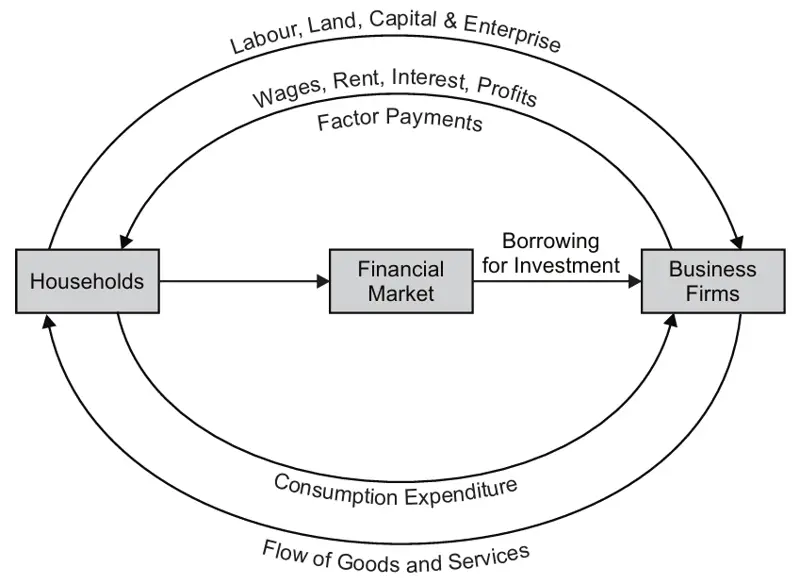
Resources such as land, labor, capital and entrepreneur flow from households to firms, goods and services flow from firms to households. This is the real flow which includes flow of resources and goods.
Factor payments flow from firms to households, expenditure on goods and services flow from households to firms. This is the money flow which include incomes of factors and expenditures on goods and services.
We get national income (NI) by either adding all expenditure by households on goods and services or adding all factor payments.
Leakages
National Income has two parts, consumption and savings, thus, Y=C+S. Savings represent leakages from circular flow because they reduce household spending and flow of money in the circular flow diagram. Reduced spending encourage firms to hire fewer workers leading to fall in employment and national income.
Role of Financial Institutions
When households deposit these savings in financial markets. Firms borrow these savings to purchase new capital goods. Firms will hire more labor which increase employment and national income Thus, investment represents injections of money into the circular flow.
Saving-Investment Identity in National Income Accounts
In two-sector economy with financial markets total output has two types of expenditure, consumption and investment. Thus,
Y = C + I
We also know that national income is either saved or consumed, so,
Y = C + S
Now, equating both equations, we get:
C + I = C + S
I = S
Thus, in our simple two-sector economy, with neither government nor foreign trade, investment (I) is identically equal to saving (S).
Assumptions
- Households own all factors of production
- Two sector economy with no government and foreign sector
- Households either consume or save, Y=C+S
- Households save some part of their income in financial institutions
- Firms borrow from financial markets to invest
- No depreciation of capital
LQ 5: What is the Circular flow of National Income? Explain circular flow in the three-sector economy with diagram.
Circular Flow of National Income
Circular flow of national income is a graphic representation of how income, resources, goods and services flow between different sectors of the economy. These sectors are households, firms, government and the foreign sector.
Three Sector Economy
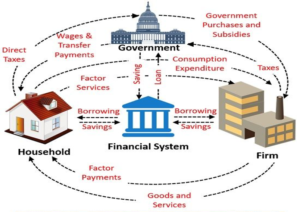
A three-sector economy is a closed economy model that consists of households, firms, and the government. The government collects taxes from households and firms and provides public goods and services. It influences the economy in three main ways:
- Spending
- Taxing
- Borrowing
Spending: The government purchases goods and services from both households and firms to provide public services such as highways, power, communication, defense, education, and public health. It also makes factor payments when it hires labor or other resources. This is shown by the flow of money from the government to households and firms.
Taxing and transfer payments: The government collects taxes from households and firms, shown by the flow of money from households and firms to the government. It also makes transfer payments and provides subsidies, shown by the flow of money from the government back to households and firms.
Borrowing: The government may borrow from financial markets to finance its budget deficit. This is represented by the flow of money from the financial market to the government.
S+T=I+G Identity in Three-Sector Economy
In three-sector economy total output of the economy has three types of expenditure (TE):
- Consumption expenditure (household expenses on final goods and services)
- Investment expenditure (firm expenses on new capital goods)
- Government expenditure (Government purchases of goods and services)
Thus,
TE = C + I + G
Now note that total income received by all individuals in the economy is spent on consumption, saving and taxes. Thus,
Y = C + S + T
Since total expenditure must be equal to total income
C + I + G = C + S + T
I + G = S + T
Crowding Out
By rearranging we obtain
G − T = S − I
When G>T, Government runs budget deficit. It borrows from financial markets to cover its deficit which raises the demand for funds and increase interest rate. Increase in interest rate lowers private investment (I), so S>I. This is known as crowding out.
National saving is the sum of private and public savings.
S = (Y − C − T) + (T − G)
S = Y − C − G
For equilibrium in financial market
Y − C − G = I
Assumptions
- Three sector economy with no foreign sector
- Households save some part of their income in financial institutions
- Firms borrow from financial markets to invest
- No depreciation of capital
- Govt. imposes taxes on households and firms
- Govt. make transfer payments and subsidies
LQ 6: What is National Income? Explain different approaches to measure NI.
National Income
Alfred Marshall in his book “Principles of Economics” in 1890 defines NI as “NI is the sum of all physical goods produced, and services provided by utilizing all its natural resources with the help of capital and labor. Net income from abroad is also included.”
Approaches to measure National Income
- Income approach
- Expenditure approach
- Product / market value / value added approach
1. Income Approach
Under the Income Method, national income is obtained by summing up all incomes earned by the people by providing their own services (labour) and the services of their property such as land and capital. It includes the following components:
- Compensation of employees
- Wages and salaries in cash
- Wages and salaries in kind
- Employers’ contribution to social security schemes
- Rent and royalty
- Interest
- Profits
- Dividends
- Undistributed profits
- Corporate income tax
- Mixed income of the self-employed including wages, rent, interest and profit
Formula
Y = R + W + i + Π
Precautions
- Transfer payments are not included
- Money earned from illegal sources not included
- Windfall gains not included
- Sale of second-hand goods are not included
2. Expenditure Approach
It measures NI by adding up all the spending on final goods and services during a given period by households, firms, government, and foreigners. These expenditures include:
- Consumption Expenditure: Spending by households on consumer goods and services, except for purchases of new housing. These include expenditure on durable goods, nondurable goods and services.
- Investment Expenditure: Purchase of new capital goods by firms for further production. It is the sum of business fixed investment, residential investment, and inventory investment.
- Government Expenditure: Purchases by the federal, state, and local government of public goods and services such as military equipment, infrastructure, salaries of govt. servants etc.
- Net Exports: Net exports equal the difference between exports and imports. NX=X-M.
Formula
Y = C + I + G + NX
Precautions
- expenditure made on second-hand goods should not be included
- Purchase of shares and bonds not included
- Exclude expenditure on intermediate goods
3. Value Added or Output Approach
This approach measures national income by adding up the total market value of all final goods and services or value added at each stage of production. This approach divides the economy into various sectors such as agriculture, manufacturing, transportation and communication, construction, and services.
Formula
Y = P1 × Q1 + P2 × Q2 + … + Pn × Qn
Precautions
- Only final goods should be included
- Only current output is included
- Production for self-consumption should also be included
- Services of housewives are not included
LQ 7: Discuss different tax and non-tax revenues of the govt.
Tax Revenue
Tax revenues are the revenues collected by government through various forms of taxes such as direct taxes, and indirect taxes.
Direct Taxes
Direct tax is a tax that is imposed directly on the income or profits of individuals and businesses, and their burden cannot be shifted to others. It is borne by those on whom they are levied. Examples are income tax, wealth tax, property tax, corporate tax, capital gain tax.
Types of Direct Taxes
Income Tax: Income tax is imposed on the income that is being earned in a financial year. The tax is paid based on income tax slabs.
Property Tax: Property tax is a tax levied on the value of immovable property, such as land and buildings. In Pakistan, property tax is charged by the local government authorities.
Capital Gains Tax: Capital gains tax is a tax levied on the profit earned from the sale of an asset. In Pakistan, capital gains tax is charged on the sale of immovable property, shares, securities, and other assets.
Corporate Tax: Corporate income tax is levied on income earned by organizations and various business entities.
Miscellaneous: Land Revenue, Agriculture-Income tax, urban immovable property tax etc.
Indirect Taxes
Indirect taxe is a tax those whose burden can be shifted to others so that those who pay these taxes do not bear the whole burden but pass it on wholly or partly to others. These taxes are levied on goods and services, and producers or sellers include the tax in the price of the product.
Types of indirect Taxes
Federal Excise Duty: Federal Excise Duty (FED) is a tax levied on specific goods and services produced and consumed in Pakistan. FED is charged on a wide range of items, including cigarettes, cement, sugar, beverages, and petroleum products.
Custom duty: Customs Duty is a tax levied on imported or exported goods. It is charged by the Federal Board of Revenue (FBR) at the time of import or export.
Sales tax Sales tax is a tax levied on the sale of goods and services. This tax is added in the price of a good thus consumers pay the taxes at the time of purchase of goods. In Pakistan it is levied at federal and provincial levels.
Miscellaneous: Gas and Petroleum Surcharge, Foreign Travel Tax, Sales Tax on Services, Stamp duty, electricity duty, Motor Vehicle tax, cotton fee etc.
Non-Tax Revenues
Non-tax revenue is the revenue collected by the government from sources other than taxes. These include:
- Profits on state owned enterprises
- Fees for providing specific services by the govt. such as education fee, registration fee etc.
- Fines and penalties imposed by govt. on violation of laws such as traffic challan.
- Gants, gifts and aid received from people and other govts of other countries.
- Prices of public goods and services such as airline fare, metro fares etc.
- Dividends and interest
- Royalties
- Income from selling govt. assets
