

LQ 1: Define Macroeconomics. Discuss its scope, importance and limitations.
Macroeconomics
Macroeconomics deals with the behavior and performance of the economy as a whole. It studies aggregate economic activities such as aggregate output, aggregate demand, national income, aggregate price level, employment level, international trade, business cycles etc.
Scope of Macroeconomics
The scope of macroeconomics refers to the areas covered by it. These areas include various theories such as:
Theory of National Income
Macroeconomics studies concepts, components, methods, and difficulties of measuring national income. These estimates are used to compare economic performance over time and across countries.
Theory of Income and Employment
It explains the determination of national income and employment using AD–AS and IS–LM models. It includes Classical and Keynesian theories and examines causes and effects of unemployment.
Theory of Business Cycles
It studies short-run fluctuations in economic activity called business cycles. The four phases are expansion, recession, depression, and recovery.
Theory of Consumption and Investment
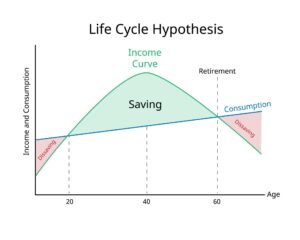
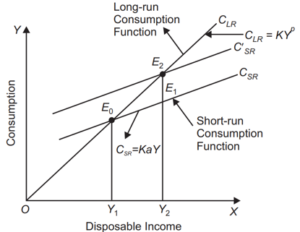
A major part of the economy’s output is spent on consumption. It examines major consumption theories such as Absolute, Relative, Permanent Income, and Life Cycle hypotheses. Investment is the most volatile component of AD. It also studies determinants of investment and the relationship between interest rate and investment.
Theory of Money and Banking
It analyzes money supply, interest rate determination, inflation, and money demand. It also studies banking functions and the relationship between inflation and unemployment.
Theory of Economic Stabilization
It deals with problems like inflation, unemployment, inequality, BOP deficit, and budget deficit. The role of fiscal and monetary policies is examined to stabilize the economy.
Theory of Economic Growth
It focuses on long-term growth and development of the economy. Major growth models include Harrod–Domar, Solow, and other modern theories.
Theory of International Trade
It studies causes of trade, exchange rate determination, and BOP and BOT issues. Major theories include Absolute Advantage, Comparative Advantage, and Heckscher–Ohlin model.
Importance of Macroeconomics
- Macroeconomics explains how total output, income, employment, and prices interact at national and global levels.
- It measures economic performance over time and across countries using indicators like GNP and National Income.
- It guides governments and central banks in designing fiscal and monetary policies to achieve growth and stability.
- It helps understand and control economic fluctuations such as booms, recessions, and depressions.
- It enables prediction of economic trends, policy impacts, and external economic shocks.
- It assists firms and investors in making decisions on production, investment, pricing, and expansion.
Limitations of Macroeconomics
- Macroeconomics assumes uniform behavior of consumers and firms, ignoring individual differences.
- An increase in aggregate measures like national income may not reflect improvement in individual welfare.
- What is beneficial for an individual may be harmful for the economy as a whole.
LQ 2: Define national Income. Discuss various concepts of national income.
National Income
NI is the sum of all physical goods produced, and services provided by utilizing all its natural resources with the help of capital and labor. Net income from abroad is also included.”
Various Concepts of National Income
- Gross Domestic Product (GDP)
- Gross National Product (GNP)
- Net National Product (NNP)
- National Income (NI)
- Personal Income (PI)
- Disposable Personal Income (DPI)
- Per Capita Income (PCI)
Gross Domestic Product (GDP)
Gross domestic product (GDP) is the total market value of all final goods and services produced within a country in a given period of time.
Important Points
- Production occured only in current year are included.
- It includes only final output.
- It includes output produced in domestic country regardless of nationality.
Formula
GDP = P1 × Q1 + P2 × Q2 + … + Pn × Qn
Gross National Product (GNP)
Gross national product (GNP) is the total market value of all final goods and services produced by the residents of a nation irrespective of geographical boundary.
Formula
GNP = GDP + NFIA
NFIA = Factor income received from abroad – Factor income paid to foreigners
Net National Product (NNP)
Net national product (NNP) is the net market value of all final goods and services produced by residents of a country in a year after deducting depreciation of fixed capital.
NNP = GNP – Depreciation
Depreciation is the wear and tear on the economy’s stock of equipment, plants, machines and residential structures.
National Income (at Factor Cost)
National income (at factor cost) is the sum of all incomes earned by the four factors of production—land, labour, capital, and entrepreneurship—in the form of rent, wages, interest, and profit by producing net output. It measures how much everyone in the economy has earned.
Formula 1:
NI = R + W + i + Π
Fromula 2:
NIfc = NNPmp – Net Indirect Taxes
Net Indirect Taxes = Indirect Taxes – Subsidies
Personal Income (PI)
Personal income (PI) is the sum of all incomes actually received by all individuals or households during a given year.
Formula:
PI = National Income
– Corporate Income Tax
– Undistributed Corporate Profits
– Social Security Contributions
+ Dividends
+ Transfer Payments
+ Personal Interest Income
Disposal Personal Income (DPI)
Disposable Personal Income (DPI) is the net income available to households after deducting personal taxes such as income tax, wealth tax, inheritance tax, etc. This income can either be spent on consumption or saved.
DPI = PI – Personal Taxes
DPI = C + S
Per Capital income (PCI)
Per capita income is the average income of all people in a country. It is the measure of average standard of living of the people.
Per Capita Income = National Income / Total Population
LQ 3: What is GDP? Discuss various components of GDP. OR Explain Expenditure approach to measure GDP.
GDP
Gross domestic product (GDP) is the total market value of all final goods and services produced within a country in a given period of time.
Important Points
- Production occured only in current year are included.
- It includes only final output.
- It includes output produced in domestic country regardless of nationality.
Components of GDP
- Consumption expenditure
- Investment expenditure
- Government Expenditure
- Net Exports
Thus,
GDP (Y) = C + I + G + NX
Consumption Expenditure (C)
Consumption expenditure refers to the spending of all households on consumer goods in a year except for purchases of new housing. This is the largest component of GDP. Consumer goods include durable goods, nondurable goods and services.
Consumption expenditure is directly related to disposable income of the consumer. This relationship iis represented by the consumption function.
C = f(Y)
A linear consumption function can be written as:
C = C0 + cY
Investment Expenditure (I)
Investment expenditure refers to the spending of firms on the purchase of new capital goods that will be used in the future to produce more goods and services such as housing, plants, equipment, and inventory in a year. Investment is the sum of three types of investment:
- Business fixed investment: It refers to the investment in the fixed capital such as buildings, machines, tools and equipment.
- Residential investment It refers to the expenditure make on constructing or buying new houses or apartments for the purpose of living or renting out to others.
- Inventory investment: It refers to the increase in firm`s inventory of goods. Inventories may include raw material, semi-finished goods and finished goods.
Government Expenditure (G)
Government expenditures are the purchases of goods and services by the federal, state, and local government to provide public goods and services. These services include defense, law and order, infrastructure, health and education etc. Govt. transfer payments are not included in GDP because they are not made in exchange for a currently produced good or service.
Net Exports (NX)
Net exports is the difference between exports and imports.
- Exports (X) are foreign spending on domestic production. Exports are included in a country`s GDP.
- Imports (M) are domestic spending on foreign production. Imports are excluded from country`s GDP.
Thus,
NX = X − M
- Net Exports are positive if exports are greater than imports.
- Net exports are negative if imports are greater than exports.
- Net exports are zero if exports and imports are equal.
GDP Calculation Example
- Personal Consumption Expenditure (C) = 6,500
- State Government Consumption (G) = 500
- Central Government Consumption (G) = 2,000
- Change in Inventories (I) = 100
- Gross Private Domestic Fixed Investment (I) = 1,200
- Exports (X) = 900
- Imports (M) = 1,200
GDP Calculation:
GDP = C + I + G + X − M
GDP = 6,500 + 1,200 + 100 + 500 + 2,000 + 900 − 1,200
GDP = 10,000
LQ 4: What is the Circular flow of National Income? Explain circular flow in the two-sector economy.
Circular Flow of National Income
Circular flow of national income is a graphic representation of how income, resources, goods and services flow between different sectors of the economy. These sectors are households, firms, government and the foreign sector.
Two Sector Economy
A two-sector economy is a simplified model of economy consisting of only two sectors, households and firms. Households provide factor services and consume goods and services. Firms use these factors to produce and sell goods and services and make factor payments.
Explanation through Diagram
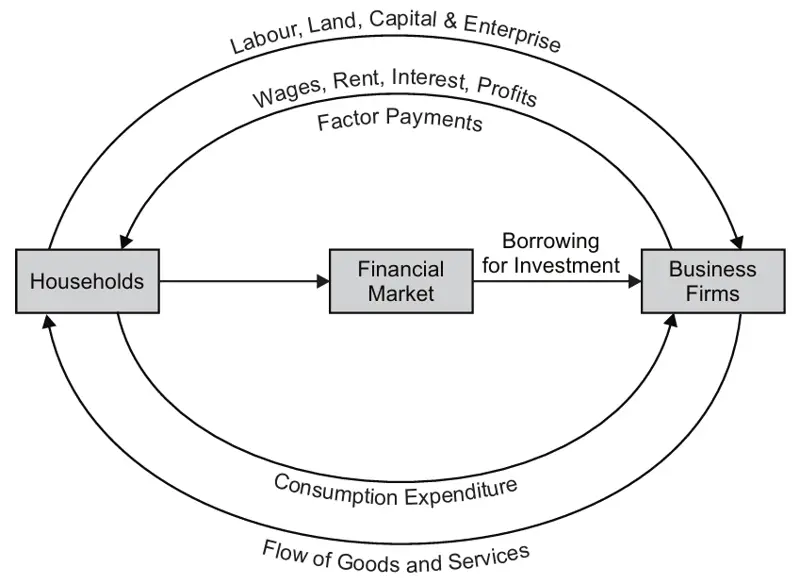
Resources such as land, labor, capital and entrepreneur flow from households to firms, goods and services flow from firms to households. This is the real flow which includes flow of resources and goods.
Factor payments flow from firms to households, expenditure on goods and services flow from households to firms. This is the money flow which include incomes of factors and expenditures on goods and services.
We get national income (NI) by either adding all expenditure by households on goods and services or adding all factor payments.
Leakages
National Income has two parts, consumption and savings, thus, Y=C+S. Savings represent leakages from circular flow because they reduce household spending and flow of money in the circular flow diagram. Reduced spending encourage firms to hire fewer workers leading to fall in employment and national income.
Role of Financial Institutions
When households deposit these savings in financial markets. Firms borrow these savings to purchase new capital goods. Firms will hire more labor which increase employment and national income Thus, investment represents injections of money into the circular flow.
Saving-Investment Identity in National Income Accounts
In two-sector economy with financial markets total output has two types of expenditure, consumption and investment. Thus,
Y = C + I
We also know that national income is either saved or consumed, so,
Y = C + S
Now, equating both equations, we get:
C + I = C + S
I = S
Thus, in our simple two-sector economy, with neither government nor foreign trade, investment (I) is identically equal to saving (S).
Assumptions
- Households own all factors of production
- Two sector economy with no government and foreign sector
- Households either consume or save, Y=C+S
- Households save some part of their income in financial institutions
- Firms borrow from financial markets to invest
- No depreciation of capital
LQ 5: What is the Circular flow of National Income? Explain circular flow in the three-sector economy with diagram.
Circular Flow of National Income
Circular flow of national income is a graphic representation of how income, resources, goods and services flow between different sectors of the economy. These sectors are households, firms, government and the foreign sector.
Three Sector Economy
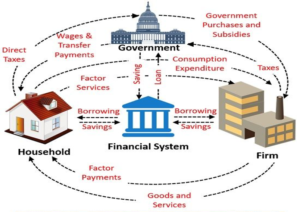
A three-sector economy is a closed economy model that consists of households, firms, and the government. The government collects taxes from households and firms and provides public goods and services. It influences the economy in three main ways:
- Spending
- Taxing
- Borrowing
Spending: The government purchases goods and services from both households and firms to provide public services such as highways, power, communication, defense, education, and public health. It also makes factor payments when it hires labor or other resources. This is shown by the flow of money from the government to households and firms.
Taxing and transfer payments: The government collects taxes from households and firms, shown by the flow of money from households and firms to the government. It also makes transfer payments and provides subsidies, shown by the flow of money from the government back to households and firms.
Borrowing: The government may borrow from financial markets to finance its budget deficit. This is represented by the flow of money from the financial market to the government.
S+T=I+G Identity in Three-Sector Economy
In three-sector economy total output of the economy has three types of expenditure (TE):
- Consumption expenditure (household expenses on final goods and services)
- Investment expenditure (firm expenses on new capital goods)
- Government expenditure (Government purchases of goods and services)
Thus,
TE = C + I + G
Now note that total income received by all individuals in the economy is spent on consumption, saving and taxes. Thus,
Y = C + S + T
Since total expenditure must be equal to total income
C + I + G = C + S + T
I + G = S + T
Crowding Out
By rearranging we obtain
G − T = S − I
When G>T, Government runs budget deficit. It borrows from financial markets to cover its deficit which raises the demand for funds and increase interest rate. Increase in interest rate lowers private investment (I), so S>I. This is known as crowding out.
National saving is the sum of private and public savings.
S = (Y − C − T) + (T − G)
S = Y − C − G
For equilibrium in financial market
Y − C − G = I
Assumptions
- Three sector economy with no foreign sector
- Households save some part of their income in financial institutions
- Firms borrow from financial markets to invest
- No depreciation of capital
- Govt. imposes taxes on households and firms
- Govt. make transfer payments and subsidies
LQ 6: What is National Income? Explain different approaches to measure NI.
National Income
Alfred Marshall in his book “Principles of Economics” in 1890 defines NI as “NI is the sum of all physical goods produced, and services provided by utilizing all its natural resources with the help of capital and labor. Net income from abroad is also included.”
Approaches to measure National Income
- Income approach
- Expenditure approach
- Product / market value / value added approach
1. Income Approach
Under the Income Method, national income is obtained by summing up all incomes earned by the people by providing their own services (labour) and the services of their property such as land and capital. It includes the following components:
- Compensation of employees
- Wages and salaries in cash
- Wages and salaries in kind
- Employers’ contribution to social security schemes
- Rent and royalty
- Interest
- Profits
- Dividends
- Undistributed profits
- Corporate income tax
- Mixed income of the self-employed including wages, rent, interest and profit
Formula
Y = R + W + i + Π
Precautions
- Transfer payments are not included
- Money earned from illegal sources not included
- Windfall gains not included
- Sale of second-hand goods are not included
2. Expenditure Approach
It measures NI by adding up all the spending on final goods and services during a given period by households, firms, government, and foreigners. These expenditures include:
- Consumption Expenditure: Spending by households on consumer goods and services, except for purchases of new housing. These include expenditure on durable goods, nondurable goods and services.
- Investment Expenditure: Purchase of new capital goods by firms for further production. It is the sum of business fixed investment, residential investment, and inventory investment.
- Government Expenditure: Purchases by the federal, state, and local government of public goods and services such as military equipment, infrastructure, salaries of govt. servants etc.
- Net Exports: Net exports equal the difference between exports and imports. NX=X-M.
Formula
Y = C + I + G + NX
Precautions
- expenditure made on second-hand goods should not be included
- Purchase of shares and bonds not included
- Exclude expenditure on intermediate goods
3. Value Added or Output Approach
This approach measures national income by adding up the total market value of all final goods and services or value added at each stage of production. This approach divides the economy into various sectors such as agriculture, manufacturing, transportation and communication, construction, and services.
Formula
Y = P1 × Q1 + P2 × Q2 + … + Pn × Qn
Precautions
- Only final goods should be included
- Only current output is included
- Production for self-consumption should also be included
- Services of housewives are not included
LQ 7: Discuss different tax and non-tax revenues of the govt.
Tax Revenue
Tax revenues are the revenues collected by government through various forms of taxes such as direct taxes, and indirect taxes.
Direct Taxes
Direct tax is a tax that is imposed directly on the income or profits of individuals and businesses, and their burden cannot be shifted to others. It is borne by those on whom they are levied. Examples are income tax, wealth tax, property tax, corporate tax, capital gain tax.
Types of Direct Taxes
Income Tax: Income tax is imposed on the income that is being earned in a financial year. The tax is paid based on income tax slabs.
Property Tax: Property tax is a tax levied on the value of immovable property, such as land and buildings. In Pakistan, property tax is charged by the local government authorities.
Capital Gains Tax: Capital gains tax is a tax levied on the profit earned from the sale of an asset. In Pakistan, capital gains tax is charged on the sale of immovable property, shares, securities, and other assets.
Corporate Tax: Corporate income tax is levied on income earned by organizations and various business entities.
Miscellaneous: Land Revenue, Agriculture-Income tax, urban immovable property tax etc.
Indirect Taxes
Indirect taxe is a tax those whose burden can be shifted to others so that those who pay these taxes do not bear the whole burden but pass it on wholly or partly to others. These taxes are levied on goods and services, and producers or sellers include the tax in the price of the product.
Types of indirect Taxes
Federal Excise Duty: Federal Excise Duty (FED) is a tax levied on specific goods and services produced and consumed in Pakistan. FED is charged on a wide range of items, including cigarettes, cement, sugar, beverages, and petroleum products.
Custom duty: Customs Duty is a tax levied on imported or exported goods. It is charged by the Federal Board of Revenue (FBR) at the time of import or export.
Sales tax Sales tax is a tax levied on the sale of goods and services. This tax is added in the price of a good thus consumers pay the taxes at the time of purchase of goods. In Pakistan it is levied at federal and provincial levels.
Miscellaneous: Gas and Petroleum Surcharge, Foreign Travel Tax, Sales Tax on Services, Stamp duty, electricity duty, Motor Vehicle tax, cotton fee etc.
Non-Tax Revenues
Non-tax revenue is the revenue collected by the government from sources other than taxes. These include:
- Profits on state owned enterprises
- Fees for providing specific services by the govt. such as education fee, registration fee etc.
- Fines and penalties imposed by govt. on violation of laws such as traffic challan.
- Gants, gifts and aid received from people and other govts of other countries.
- Prices of public goods and services such as airline fare, metro fares etc.
- Dividends and interest
- Royalties
- Income from selling govt. assets
LQ 8: Define aggregate demand. Discuss its components.
Aggregate demand is the total quantity of goods and services demanded by all households, all firms, government and foreign sector in a year. It is the sum of consumption, investment, government expenditure and net exports. Aggregate demand depends negatively general price level P, the higher P, lower will be the quantity of goods and services demanded Y and vice versa.

Components of Aggregate Demand
There are four components of aggregate demand.
- Consumption demand
- Investment demand
- Government expenditure
- Net Exports
Consumption Demand
Consumption demand refers to the demand for final goods and services by all households in the economy. Consumption is the largest component of AD. Consumption demand depends positively on disposable income. Other factors that affect consumption are price level, (P) fiscal policy like direct taxes (T), interest rate (i), expected price level (Pe) etc. A linear consumption demand function can be written as:

Investment Demand (I)
Investment demand refers to the expenditure on the purchase of new capital goods by firms. It includes:
- Business fixed investment such as machines, buildings and tools etc.
- Residential investment like new homes and apartments etc.
- Inventories (goods that firms produce now but intend to sell later).
Investment decisions largely depend on two things, the interest rate which is the cost of borrowing the capital and the expected future return on that investment. Investment is profitable if interest rate is less than expected returns.

Government Demand (G)
Government demand are the purchases of goods and services by the federal, state, and local government to provide public goods and services. These services include defense, law and order, infrastructure, health and education etc. Govt. demand is autonomous, it means it is not directly affected by interest rate or income level. The reasoning is that government spending is primarily the result of a political decision.
Net Exports (NX)
Net exports is the difference between exports and imports. Exports are the goods that are produced domestically and consumed by foreigners, imports are the goods produced by foreigners and consumed domestically. Thus, net exports is the net demand for domestic goods. Key determinants of net exports are exchange rate and terms of trade.

- NX will be positive if exports are greater than imports
- NX will be negative if imports are greater than exports
LQ 9: Define inflation. Describe and explain types, causes, effects, and remedies of inflation.
Definition
Inflation is a sustained increase in the general price level of goods and services in an economy over time. When the general price level increases purchasing power of money falls, and each unit of money buys fewer goods and services.
Types of Inflation
Based on Causes
- Demand-Pull Inflation: It is also known as Excess Demand Inflation takes place when aggregate demand for goods or services exceeds to its aggregate supply.
- Cost-Push Inflation: It occurs when cost of producing goods and services are increasing. It is also known as “New Inflation theory”. It is caused by supply–side factors such as higher wage push, profit push and higher costs of raw material.
- Structural Inflation: This type of inflation often experienced in developing countries which is caused by structural rigidities such as agricultural backwardness, resource constraints, foreign exchange restrictions, physical infrastructural restrictions etc.
- Scarcity Inflation: This occurs due to hoarding and speculation by traders and black marketers so as to create an artificial shortage of essential goods like food grains, kerosene oil etc.
Based on Rate
- Creeping Inflation: A very low and gradual rise in prices (about 2–3% annually).
- Walking Inflation: A moderate increase in prices ranging from 3% to 10% per year.
- Running Inflation: A rapid rise in prices exceeding 10% annually
- Galloping Inflation: A very high inflation rate (20% to 1000% annually) with fast-rising prices
- Hyperinflation: An extremely high and uncontrollable rise in prices exceeding 1000% per year. Examples include: Germany in 1923, Zimbabwe in 2008, Venezuela in 2020.
Causes of Inflation
- Demand-Pull Inflation: Demand-pull inflation occurs when aggregate demand exceeds aggregate supply in the economy. It is caused by increases in consumption, investment, government spending, or exports. When demand rises faster than supply, prices increase.
Cost-Push Inflation: Cost-push inflation arises due to an increase in the cost of production, such as higher wages, raw material prices, or energy costs. This reduces aggregate supply and forces firms to raise prices. Common examples include oil price shocks.
Monetary Inflation: Monetary inflation occurs when there is an excessive increase in the money supply in the economy. A higher money supply increases purchasing power and demand for goods and services. If output does not increase accordingly, prices rise.
Structural Inflation: Structural inflation is common in developing economies due to structural weaknesses. These include poor infrastructure, outdated agricultural practices, and inefficient resource allocation, which limit supply.
Fiscal Inflation: Fiscal inflation occurs when the government runs large budget deficits and finances them through borrowing or printing money. This increases aggregate demand without a corresponding increase in supply.
Exchange Rate Depreciation: When the domestic currency depreciates, imports become more expensive, increasing production costs (cost-push inflation). At the same time, exports become cheaper, increasing demand (demand-pull inflation).
- Inflation Expectations: Inflation expectations refer to people’s beliefs about future inflation. If firms expect higher inflation, they increase prices in advance, while workers demand higher wages. This leads to a self-fulfilling cycle of rising inflation.
Effects of inflation
Negative Effects of inflation
- Fixed Income Group: When inflation increases, the purchasing power of the fixed-income and low-income groups decreases.
- Impact on inequality: During inflation profits of businessmen increase due to an increase in the prices of the products, and the real income of the fixed-income group decreases.
- Investment: Inflation raises production costs, leading to higher prices and further inflationary pressure.
- Lenders: Inflation harms lenders because the real value of money they receive decreases.
- Savings: Inflation discourages savings as people spend more to maintain their living standards.
- Balance of Payments: Inflation worsens balance of payments by reducing exports and increasing imports.
Positive Effects of inflation
- Higher Profits: Inflation increases profits of producers due to higher selling prices.
- Increase in Production: Higher profits encourage firms to expand production.
- Employment and Income: Increased production raises employment and income levels.
- Shareholders’ Income: Inflation can increase dividend income for shareholders due to higher profits.
- Borrowers: Inflation benefits borrowers as they repay loans with money of lower real value.
Remedial Measures of Inflation
Demand-Side Policies
Demand-side policies aim to control inflation by reducing aggregate demand in the economy.
Monetary Measures
- Increase in Bank Rate: Higher interest rates discourage borrowing and reduce spending.
- Open Market Operations: Sale of government securities reduces money supply and price level.
- Increase in Reserve Ratio: Higher reserve requirements limit bank lending and reduce money supply.
Fiscal Measures
- Increase in Taxes: Higher taxes reduce disposable income and aggregate demand.
- Decrease in Government Spending: Lower public expenditure reduces demand and inflationary pressure.
Direct Measures
- Increase in Voluntary Savings: Encouraging savings reduces consumption and aggregate demand.
- Deferred Pay Scheme: Part of income is saved and released after inflation, reducing current demand.
Supply-Side Policies
Supply-side policies focus on increasing production and reducing costs to control inflation.
- Investment in Infrastructure: Improves productivity and lowers production costs.
- Deregulation and Subsidies: Enhances efficiency and reduces business costs.
- Education and Training: Improves labor productivity and increases output.
- Wage-Price Controls: Government restricts excessive increases in wages and prices.
Exchange Rate Policy
- Exchange Rate Appreciation: A stronger currency makes imports cheaper and helps reduce inflation.
LQ 10: What is meant by fiscal policy? What are its objectives, and explain fiscal policy tools.
Definition of Fiscal Policy
Fiscal policy refers to the use of government spending and taxation to influence the overall economic activity. It is mainly used to control economic growth, inflation, unemployment, and income distribution.
Objectives of Fiscal Policy
- Economic Growth: The government increases spending on infrastructure, education, and health to promote long-term economic growth.
- Price Stability (Control of Inflation): Fiscal policy helps control inflation by:
- Reducing government spending
- Increasing taxes to reduce excess demand
- Full Employment: Government creates job opportunities through public projects and investment to reduce unemployment.
- Equitable Distribution of Income: Taxes (like progressive taxes) and subsidies are used to reduce income inequality between the rich and the poor.
- Balance of Payments Stability: Fiscal measures such as taxes on imports or incentives for exports help manage the external trade balance.
- Economic Stability: Fiscal policy helps stabilize the economy during booms and recessions by adjusting spending and taxation.
- Poverty alleviation: Tools like cash transfers, food programs, and housing are used to alleviate poverty.
Tools of Fiscal Policy
- Taxation
Taxation is the most important tool of fiscal policy. It directly affects disposable income, consumption, and investment.
Types of Taxes
- Direct Taxes: Imposed directly on income and wealth (e.g., income tax, corporate tax)
- Indirect Taxes: Imposed on goods and services (e.g., sales tax, GST)
- Government Expenditure
Govt. spending directly affects the aggregate demand.
Types of Expenditure
- Development Expenditure: Infrastructure, education, health
- Non-Development Expenditure: Defense, administration
- Transfer Payments: Pensions, unemployment benefits, subsidies
- Public Borrowing and Management
When government expenditure exceeds revenue, it borrows. Proper debt management is necessary to avoid unnecessary borrowing.
Sources of Borrowing
- Internal borrowing (from banks, public through bonds)
- External borrowing (from foreign institutions like IMF, World Bank)
- Annual Budget Policy
Budget is an annual financial statement of the revenue and heads of expenditure of the government in the coming financial year. In recession the government often uses deficit budget policy to stimulate demand.
Types of Budgets
- Balanced Budget: Revenue = Expenditure
- Surplus Budget: Revenue > Expenditure (used to control inflation)
- Deficit Budget: Expenditure > Revenue (used to boost economic activity)
- Subsidies
Subsidy is direct or indirect financial support by government to individuals and businesses. It can be either in the form of cash or tax cuts. Subsidies encourage production of goods and services by reducing production support.
- Transfer payments
While transfer payments are payments made by the government to individuals for which no goods or services are provided to the government in return. For example, pensions, unemployment allowance, etc. They support low-income groups and stabilize income.
Types of Fiscal Policy
- Expansionary Fiscal Policy → Increase spending / reduce taxes (used in recession)
- Contractionary Fiscal Policy → Reduce spending / increase taxes (used to control inflation)
LQ 11: What is meant by unemployment? What are its different types, and what are their causes?
Unemployment
Unemployment refers to a situation where individuals who are able and willing to work at the prevailing wage rate cannot find jobs. It indicates the underutilization of labor resources in the economy.
Types of Unemployment
Frictional Unemployment
Frictional unemployment is short-term unemployment caused by job search and skill mismatch. It occurs when people are temporarily between jobs or entering the labor market.
Structural Unemployment
Structural unemployment arises due to long-term changes in the economy, such as technological advancement or industrial shifts. It reflects a mismatch between workers’ skills and job requirements.
Cyclical Unemployment
Cyclical unemployment is caused by economic fluctuations (business cycles). It increases during recessions when demand for goods and labor falls below normal levels.
Underemployment
Underemployment occurs when individuals are working below their full capacity or skill level. This includes part-time workers seeking full-time jobs or overqualified individuals in low-skill jobs.
Seasonal Unemployment
Seasonal unemployment occurs due to seasonal variations in demand for labor. It is common in industries like agriculture, tourism, and construction during off-seasons.
Transitory Unemployment
Transitory unemployment is temporary unemployment during job transitions. It occurs when individuals are switching jobs or waiting to start a new one.
Voluntary Unemployment
Voluntary unemployment exists when individuals choose not to work despite available job opportunities. Such individuals are not considered part of the labor force.
Involuntary Unemployment
Involuntary unemployment occurs when people are willing to work at the current wage but cannot find jobs. It reflects excess labor supply and economic inefficiency.
Natural Rate of Unemployment (NRU)
The natural rate of unemployment is the level where only frictional and structural unemployment exist. It represents the normal functioning of the labor market.
Causes of Unemployment in Pakistan
- Rapid Population Growth: Fast population increase creates more job seekers than available employment opportunities.
- Low Economic Growth: Slow industrial and economic growth fails to generate sufficient jobs for the labor force.
- Lack of Industrial Development: Limited industrialization reduces employment opportunities, especially in the manufacturing sector.
- Agricultural Dependence: Heavy reliance on agriculture leads to seasonal and disguised unemployment.
- Poor Education System: Education does not match market needs, leading to skill mismatches and educated unemployment.
- Technological Changes: Automation and modern technology reduce the demand for unskilled labor.
- Political Instability: Uncertain political conditions discourage investment and reduce job creation.
- Lack of Investment: Low domestic and foreign investment limits business expansion and employment opportunities.
- Energy Crisis: Electricity and gas shortages reduce industrial production and cause job losses.
- Corruption and Mismanagement: Inefficient use of resources and corruption hinder economic growth and employment generation.
- Rural-Urban Migration: Migration to cities increases pressure on urban job markets, leading to unemployment.
- Limited Small and Medium Enterprises (SMEs): Lack of support for SMEs reduces job creation.
LQ 12: Define monetary policy. What are its tools and objectives?
Definition
Monetary policy refers to the actions taken by a central bank to control the money supply, credit conditions, and interest rates in order to achieve macroeconomic objectives such as price stability, full employment, and sustainable economic growth.
Tools of Monetary Policy
Broadly divided into quantitative and qualitative methods:
- Quantitative Tools
- Qualitative Tools
Quantitative Tools
1. Open Market Operations (OMO)
It involves the buying and selling of government securities in the open market.
- Buying securities → increase money supply and liquidity → prices increase.
- Selling securities → decrease money supply and liquidity → prices decreas
2. Policy Rate
The policy rate is the interest rate at which commercial banks borrow funds from the central bank.
- Lower discount rate → banks borrow more → increase money supply → increase prices
- Higher discount rate → banks borrow less → decreases money supply → lowers prices
3. Reserve Requirement Ratio (RRR)
This refers to the minimum percentage of deposits that commercial banks must hold in reserve and cannot lend out.
- Lowering RRR → banks lend more → expanding the money supply and prices
- Raising RRR → banks lend less → lowering the money supply and prices
Quantitative Tools
1. Credit Rationing
Limits the amount of credit available to certain sectors.
2. Moral Suasion
Central bank persuades banks through advice and guidelines.
3. Direct Action
Central bank may penalize or restrict banks not following policies.
4. Selective Credit Controls
Control over credit for specific purposes (e.g., consumer loans).
Objectives of Monetary Policy
1. Price Stability
The primary objective is to maintain low and stable inflation. This can be done by increasing the policy rate and RRR or selling securities.
2. Economic Growth
Monetary policy aims to promote sustainable economic development. This can be done by opting expansionary policy such as lowering interest rates which encourages investment and spending.
3. Full Employment
Monetary policy seeks to reduce unemployment. In this regard, expansionary policy is adopted by lowering interest rates which encourages investment and creates more jobs.
4. Balance of Payments Stability
Monetary policy influences interest and exchange rates to maintain a sustainable balance of payments. Higher interest rates attract foreign capital, while exchange rate changes affect export and import competitiveness..
5. Financial Stability
Monetary policy plays a key role in maintaining the stability of the financial system by ensuring adequate liquidity and acting as a lender of last resort during financial crises.
6. Exchange Rate Stability
Central banks use monetary policy to stabilize exchange rate. A stable exchange rate boosts investor confidence, supports trade, and helps control imported inflation.
Suggestions for further readings



 MinhajMetricsHub