
What is National Income (NI)
National Income (NI) is the sum of income earned by all factors like land, labor, capital and entrepreneur in form of rent, wages, interest and profit in a year. It can also be defined as the total market value of all final goods and services produced in the economy in a year. In the previous blog post, I told national income simultaneously represents three things.
- Total market value of all goods and services produced.
- Total income received by all individuals such as firms and households.
- Total expenditure made on all goods and services produced
To see previous post click here.
In this blog post I will show how these three measures of national income are equivalent through circular flow of national.
Circular Flow of National Income
Circular flow of national income is a graphic representation of how income, resources, goods and services flow between different sectors of the economy. These sectors are households, firms, government and the foreign sector. Circular flow of NI can be explained either in closed economy or open economy.
In a closed economy there is no international trade, so net exports are zero. An open economy has international trade relations with other countries so net exports can be either zero, positive or negative. The key difference is that in an open economy the total spending of a country is not always equal to its total output. Spending can be more than a country`s output by importing from abroad, less than total output by exporting the surplus output.
A closed economy can be either two-sector or three-sector. A two-sector economy is a simplified model of economy consisting of only two sectors, households and firms. Households provide factor services and consume goods and services. Firms use these factors to produce and sell goods and services and pay factor payments.
A three-sector economy is an economic model that consists of households, firms, and the government. The government collects taxes from households and firms and provides public goods and services. It influences the economy in three main ways: spending, taxing and borrowing. A four-sector economy or open economy consists of four sectors, households, firms, government and foreign sector. The four-sector economy has trade relations with other countries therefore, net exports can either be positive, negative or zero.
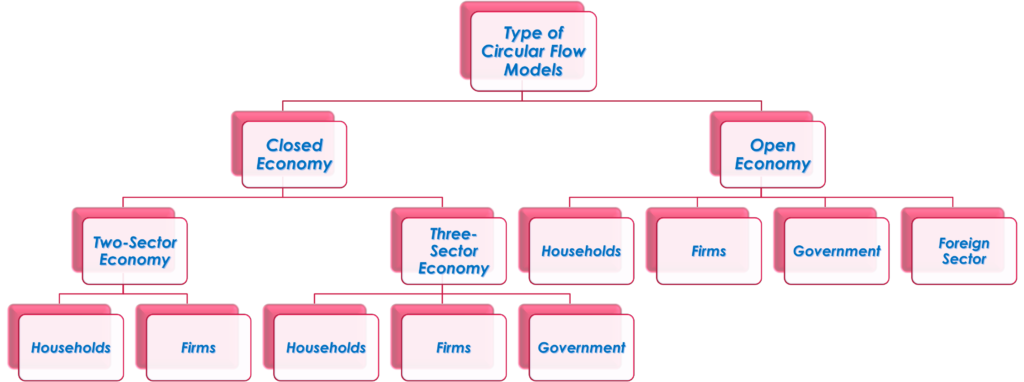 Figure 1: Types of Circular Flow Models
Types of Markets in Macroeconomics
Macroeconomics has generally three types of markets
- Goods Market
- Labor Market or resource market
- Money Market
Goods and Service Market
The products and services market, often known as the goods market, is where households, businesses, the government, and the foreign sector trade goods and services generated by corporations. Households and the government buy consumer items and public services from businesses. Firms and the government also acquire products and services from one another, such as machinery, equipment, and capital assets. The foreign sector participates through exports and imports, with domestic commodities sold abroad and foreign goods acquired by the home economy. This market determines the level of production, output, and total economic activity.
The Labor Market (or Factor Market)
The labor market, often called the factor market, is where factor services are traded. Households provide factors of production, particularly labor, whereas enterprises and the government need these factors for production and public services. Labor is exchanged not just locally but also globally, with workers providing labor to other economies and foreign labor entering domestic markets. The overall supply of labor in the economy is determined by individual household decisions, such as whether to participate in the labor force and, if so, how many hours to allocate to work and how many to leisure. In this way, the labor market determines employment, wages, and income distribution.
Money Market (or Financial Market)
The money market, also known as the financial market, facilitates the flow of funds among households, firms, governments, and the rest of the world. Households borrow to finance their expenditure such as buying new homes, new car etc, firms borrow to expand production and build new facilities, and governments borrow by issuing bonds to finance its budget and development programs. This borrowing and lending process is largely coordinated by financial institutions such as commercial banks, savings and loan associations, insurance companies, and other financial intermediaries.
Circular Flow of National Income in Two Sector Economy
Without Financial Market
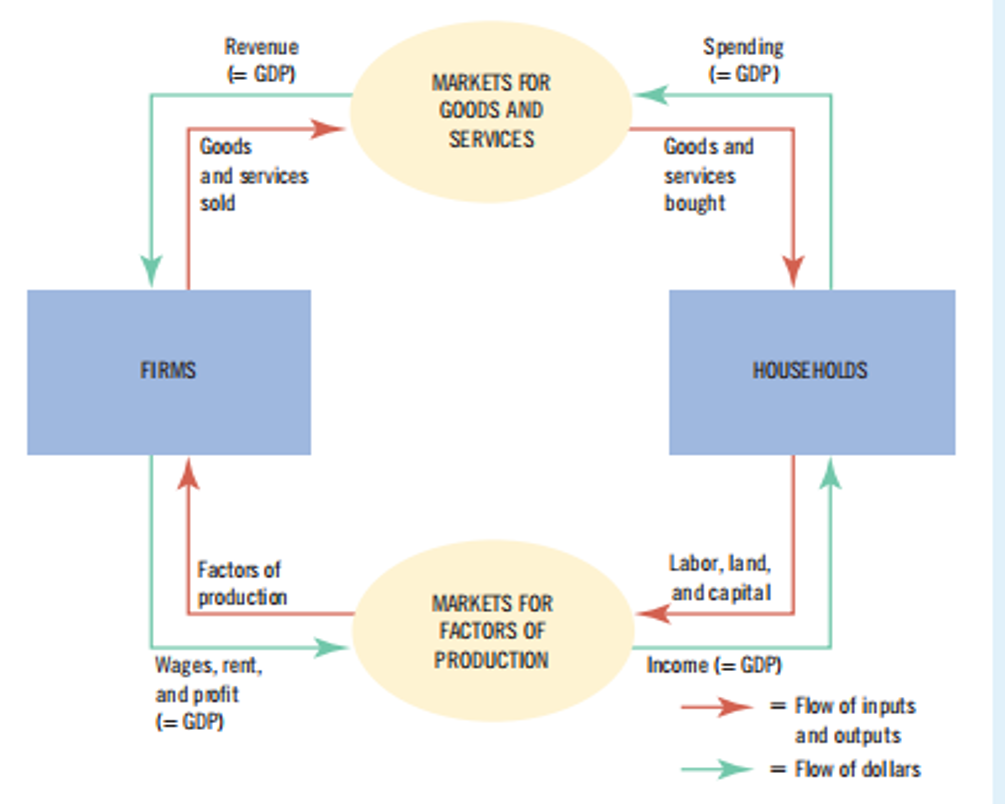 Figure 2: Circular Flow of NI in Two-Sector Economy without Financial Market
Two-sector economy is a simplified model of economy consisting of only two sectors, households and firms. Households provide factor services and consume goods and services. Firms use these factors to produce and sell goods and services and pay factor payments.
The upper part of diagram shows what happens in factor market. Resources such as land, labor capital and entrepreneurship flows from households to firms. Money flows from firms to the households as factor payments such as wages, rent, interest and profits.
The lower part of diagram shows what happens in goods market. Money flows from households to firms as consumption expenditure made by the households on the goods and services produced by the firms, while the goods and services flow in opposite direction from firms to households.
Thus, we see that money flows from firms to households as factor payments which is the income of households and then it flows from households to firms in form of consumption expenditure which is the income of firms. In this way, income of one is the expenditure made by the other. Therefore, Income=Expenditure.
There are two ways to measure national income. By adding up the total expenditure by households on goods and services or by adding up the total income (wages, rent, interest and profit) paid by firms.
Assumptions:
- Two sector economy with no government and foreign sector
- Households consume all their income, no savings, Y=C
- Firms distribute all their profits as factor payments, no savings
- Households own all factors of production
With Financial Market
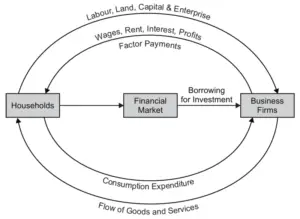 Figure 3: Circular Flow of NI in Two-Sector Economy with Financial Market
Resources flow from households to firms, goods and services flow from firms to households (real flow). Factor payments flow from firms to households, expenditure on goods and services flow from households to firms (money flow). We get NI by either adding all expenditure by households on goods and services or adding all factor payments.
National Income has two parts, consumption and savings, thus, Y=C+S. Savings represent leakages from circular flow because they reduce household spending and flow of money in the circular flow diagram. Firms will hire fewer workers leading to fall in employment and national income.
But when households deposit these savings in financial markets. Firms borrow these savings to purchase new capital goods. Firms will hire more labor which increase employment and national income Thus, investment represents injections of money into the circular flow. In this way money flows from households to financial markets in form of savings and from financial markets to firms in form of borrowing for investment.
Saving-Investment Identity in National Income Accounts
We know that in a simple two-sector economy, the total output produced (Y) has two types of expenditure, households’ expenditure on consumer durable and nondurable goods known as consumption expenditure (c) and expenditure by firms on the purchase of new capital goods such as machines, factories, equipment etc known as investment expenditure (I). Thus,
Y = C + I
We also know that national income is either saved or consumed, so,
Y = C + S
Now, equating both equations, we get:
C + I = C + S
I = S
Thus, in our simple two-sector economy, with neither government nor foreign trade, investment (I) is identically equal to saving (S).
Circular Flow of National Income in a Three Sector Economy
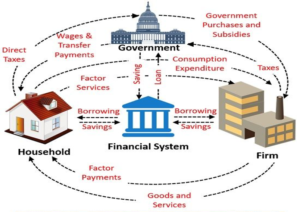
Figure 4: Circular Flow of NI in Three-Sector Economy
A three-sector economy is an economic model that consists of households, firms, and the government. The government collects taxes from households and firms and provides public goods and services. It influences the economy in three main ways:
- Spending
- Taxing
- Borrowing
Spending: The government purchases goods and services from both households and firms to provide public services such as highways, power, communication, defense, education, and public health. It also makes factor payments when it hires labor or other resources. This is shown by the flow of money from the government to households and firms.
Taxing and transfer payments: The government collects taxes from households and firms, shown by the flow of money from households and firms to the government. It also makes transfer payments and provides subsidies, shown by the flow of money from the government back to households and firms.
Borrowing: The government may borrow from financial markets to finance its budget deficit. This is represented by the flow of money from the financial market to the government.
Assumptions
- Three sector economy
- Households save some part of their income in financial institutions
- Firms borrow from financial markets to invest
- No depreciation of capital
S+T=I+G Identity in Three-Sector Economy
In three-sector economy total output of the economy has three types of expenditure (TE):
- Consumption expenditure (household expenses on final goods and services)
- Investment expenditure (firm expenses on new capital goods)
- Government expenditure (Government purchases of goods and services)
Thus,
TE = C + I + G
Now note that total income received by all individuals in the economy is spent on consumption, saving and taxes. Thus,
Y = C + S + T
Since total expenditure must be equal to total income
C + I + G = C + S + T
I + G = S + T
By rearranging we obtain
G − T = S − I
When G>T, Government runs budget deficit. It borrows from financial markets to cover its deficit which raises the demand for funds leading to increase interest rate. Increase in interest rate lowers private investment (I), so I<S. This is known as crowding out. For equilibrium in financial market flows into the financial market (national saving) must balance the flows out of the financial market (investment).
National saving is the sum of private and public savings.
S = (Y − C − T) + (T − G)
S = Y − C − G
For equilibrium in financial market
Y − C − G = I
Circular Flow of National Income in Four Sector Economy
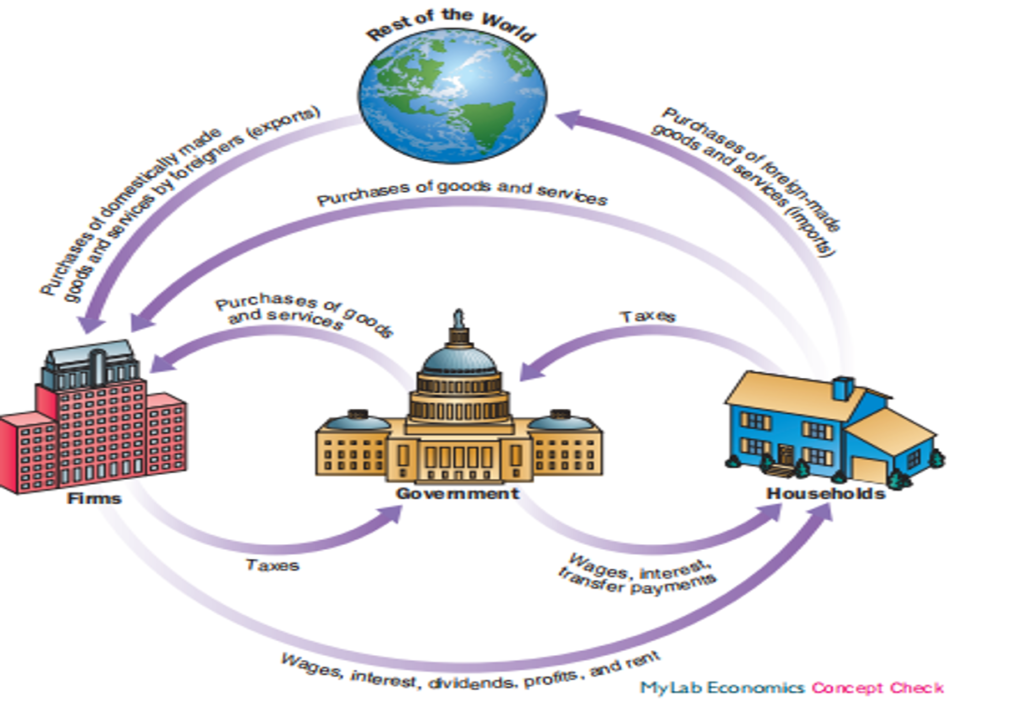 Figure 5: Circular Flow of NI in Four-Sector Economy
A four-sector economy or open economy consists of four sectors, households, firms, government and foreign sector. The four-sector economy has trade relations with other countries therefore, net exports can either be positive, negative or zero.
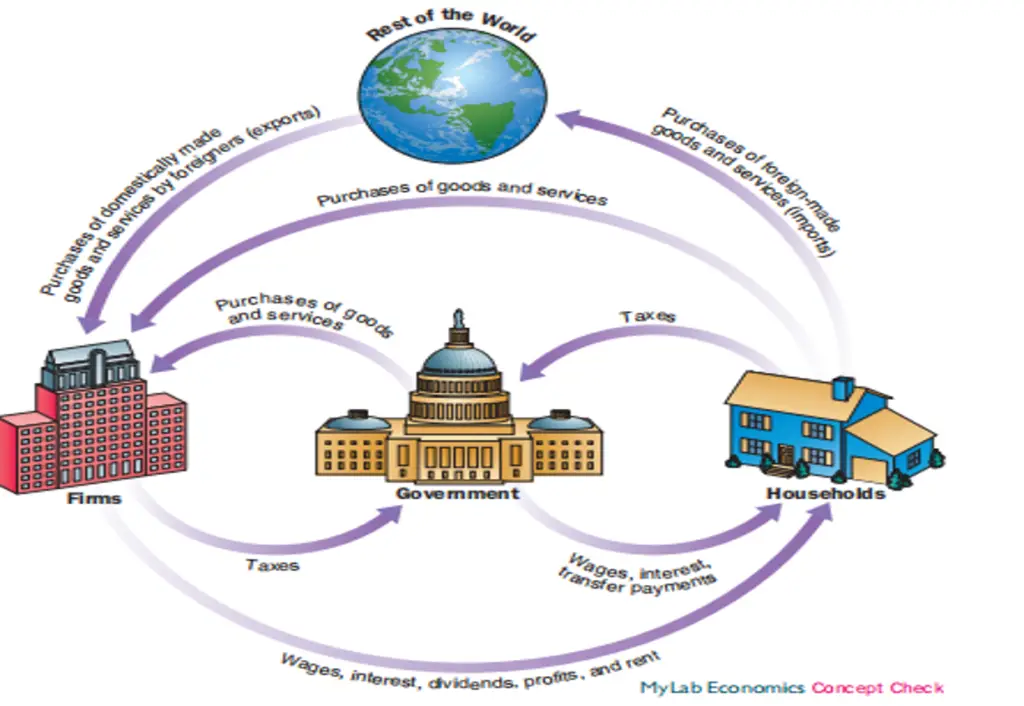
Households work for firms and the government, and they receive wages for their work. Households also receive interest on corporate and government bonds and dividends from firms. Households also receive other payments from the government without providing goods and services known as transfer payments. Together, these receipts make up the total income received by the households.
Households also have to pay for goods and services they buy from firms and taxes to government; these are households spending. If their receipts are greater than their spendings then they save and deposit their savings in financial institutions. Savings are called leakages as it withdraws money out of system. But if spending is greater than their receipts, they dissave and then borrow from financial institutions and make interest payment.
Firms sell goods and services to households and the government, Firms pay wages, interest, and dividends to households, and firms pay taxes to the government. The government collects taxes from households and firms. The government also makes payments. It buys goods and services from firms, pays wages and interest to households, and makes transfer payments to households.
Finally, households spend some of their income on imports—goods and services produced in the rest of the world. Similarly, people in foreign countries purchase exports—goods and services produced by domestic firms and sold to other countries.
One lesson of the circular flow diagram is that everyone’s expenditure is someone else’s receipt. Thus, every transaction must have two sides.
Suggestions for further readings

One Response