
Health, Education, and Economic Development
Health and Education as Objectives of Development
Education and health are basic objectives of development; they are important ends in themselves. Health is central to wellbeing, and education is essential for a satisfying and rewarding life.
Health and Education as Inputs of Development
At the same time, education and health act as inputs to economic development. Because:
- Education enables people to learn new technologies and acquire the skills necessary for a country’s growth and development. While greater education capital may improve the return on investments in health, many health programmes rely on basic skills often learned at school, including personal hygiene and sanitation.
- Good health is necessary for people to be productive. When people are healthy, they can work better and learn effectively. Education is more successful when people are healthy. Further, greater health capital may improve the return to investments in education, because health is an important factor in school attendance and in the formal learning process of a child.
Their dual role as both inputs and outputs gives health and education their central importance in economic development.
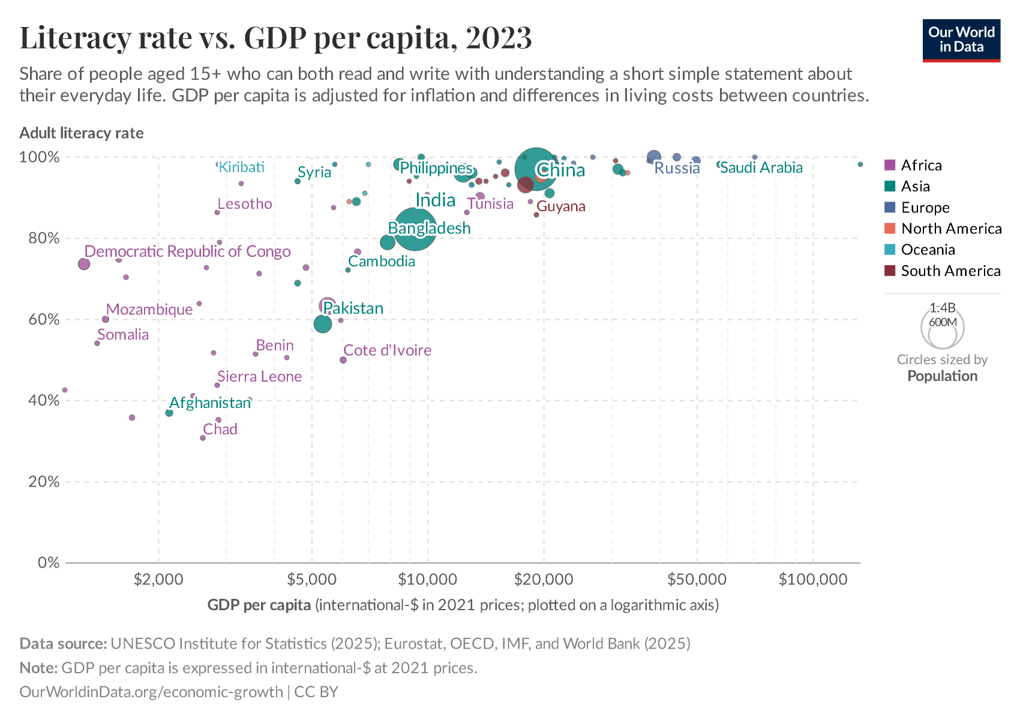
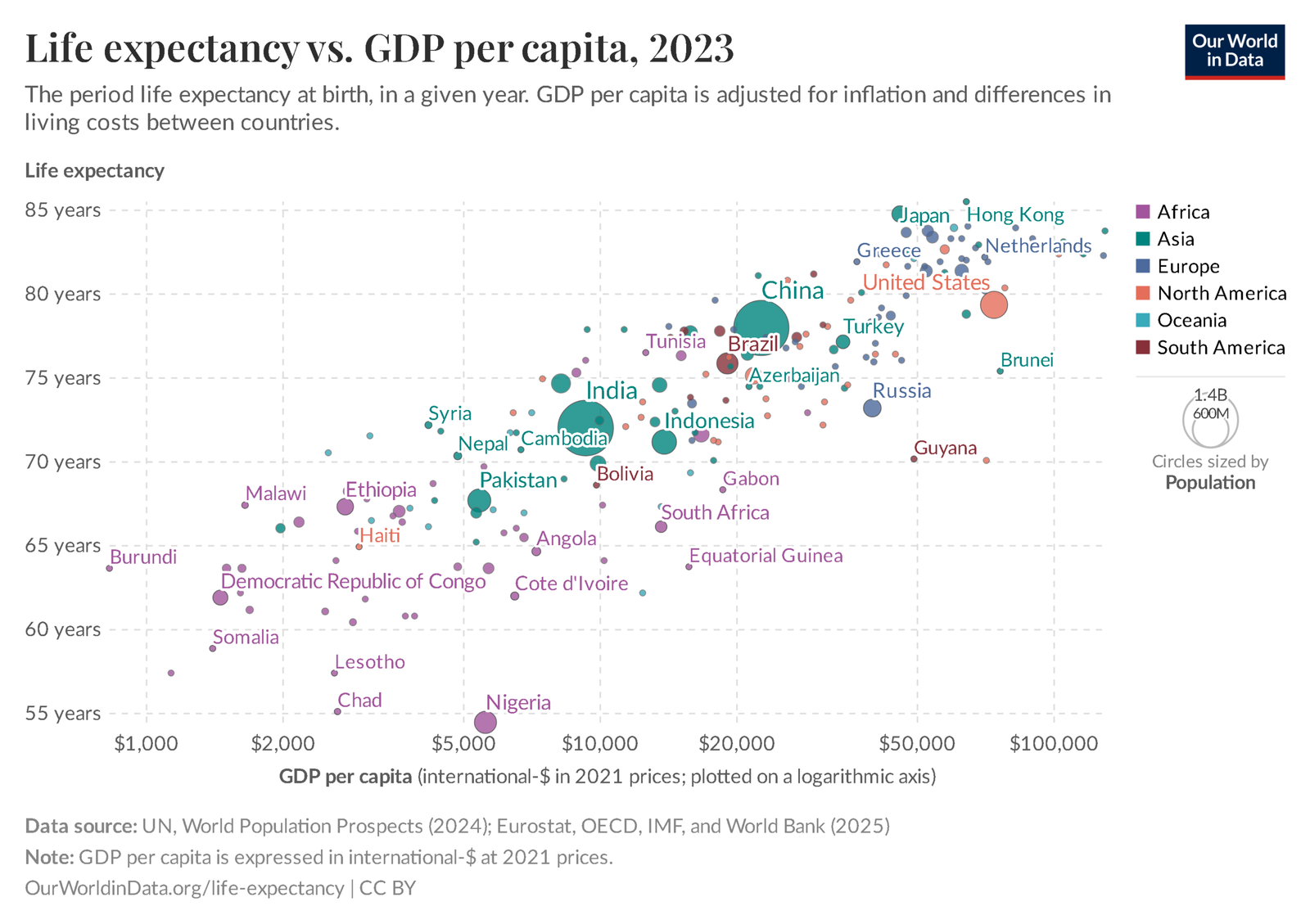
The following two diagrams show that countries with higher literacy rates and longer life expectancy tend to have higher GDP per capita, indicating a positive relationship between education, health, and economic development. Better education enhances human capital and productivity, while improved health increases labour efficiency and longevity. Together, these factors contribute to higher income levels and sustainable economic growth.
Income, Health & Education
Health and education levels are much higher in high-income countries.
- Higher Income → Better Education & Health
- Better Education & Health → Higher Income
With higher incomes, both people and governments can afford to spend more on education and health, and with better health and education, higher productivity and incomes become possible. Education improves skills; health improves the capacity to work and learn.
Policy Implication: Because of these relationships, development policy needs to focus on income, health, and education simultaneously.
Costs and Benefits of Education
Costs of Education
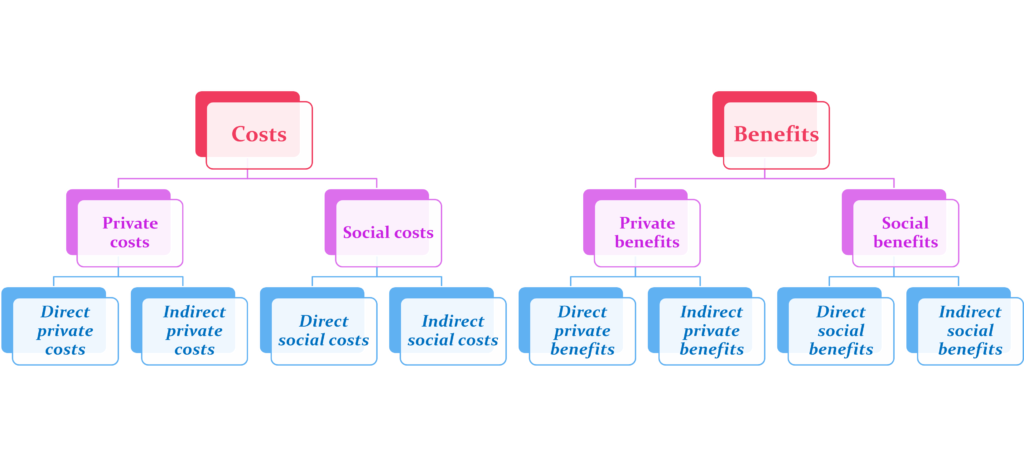
Two types of costs of education
- Private costs
- Social costs
Private Costs
Private costs refer to the direct and indirect expenses that individuals, families, or organisations incur while pursuing education. Private costs can be direct and indirect.
Direct Private cost (Out-of-Pocket Expenses)
Direct private costs or out-of-pocket expenses are the money that individuals directly pay for their education, including expenditures on:
- Challan fees
- Tuition fees
- Hostel dues
- Books & uniforms
- Transport
- Online resources
Indirect Private Cost (Opportunity Costs)
Indirect private costs are the opportunity cost of pursuing education, such as:
- Foregone earnings
- Time invested
- Delayed life milestones (buying a home or a car)
- Starting a business
- Delayed marriages, etc.
Social Costs
Social costs are the costs that are incurred by society/public/government in providing education. They are also categorised into direct and indirect social costs.
Direct Social Costs
It includes direct monetary expenditure of the government on:
- Educational infrastructure (buildings, classrooms, libraries, laboratories)
- Technology infrastructure (computers, software, online courses)
- Salaries (teaching and non-teaching staff)
- Government grants, scholarships, and bursaries
- Health services, etc.
Indirect Social Costs
It includes opportunity costs for society as a whole, such as:
- Productivity foregone — students not participating in the labour market
- Tax revenue foregone from students not working
- Pre-tax earnings are usually used as a proxy for productivity foregone
- Long-term cost of human capital formation for the nation
Benefits of Education
Private Benefits
Educational benefits accruing to individuals, families, or organisations investing in education are known as private benefits of education. These are of two types: direct and indirect private benefits.
Direct Private Benefits
These include:
- Higher lifetime earnings/income
- Greater career opportunities
- Job security and stability
- Higher social status
- Improved quality of life
Indirect Private Benefits
These are:
- Psychological satisfaction
- Movement up the socioeconomic ladder
- Better decision-making capacity
- Improved personal health awareness
- Greater civic participation
Social Benefits
Educational benefits enjoyed by the society or government from educational investment are referred to as social benefits of education. These are of two types: direct and indirect social benefits.
Direct Social Benefits
These include:
- Reduction in crime
- Improved health and nutrition
- Poverty reduction
- Increased charity
Indirect Social Benefits
These are:
- National integration
- Population control
- Inculcating productivity-related habits such as hard work, punctuality, self-reliance, etc.
- Increased capacity to save money
Investment decision on education
- Investment Decision: Individuals invest in education when expected Private Benefits > Private Costs (positive net return).
- Society invests in education when expected Social Benefits > Social Costs — justifying public funding.
Education and Earnings
Investment in education generates expected future income over the years. This expected income can be calculated by the following formula:

Where E is income with extra education, N is income without extra education, t is year, i is the discount rate used to convert future value into present value, and the summation is over expected years of working life.
The rate of return to education will be higher when
- The discount rate is lower
- Direct or indirect costs are lower,
- The benefits are higher.
Trade-offs in the decision to continue in School
Some Assumptions
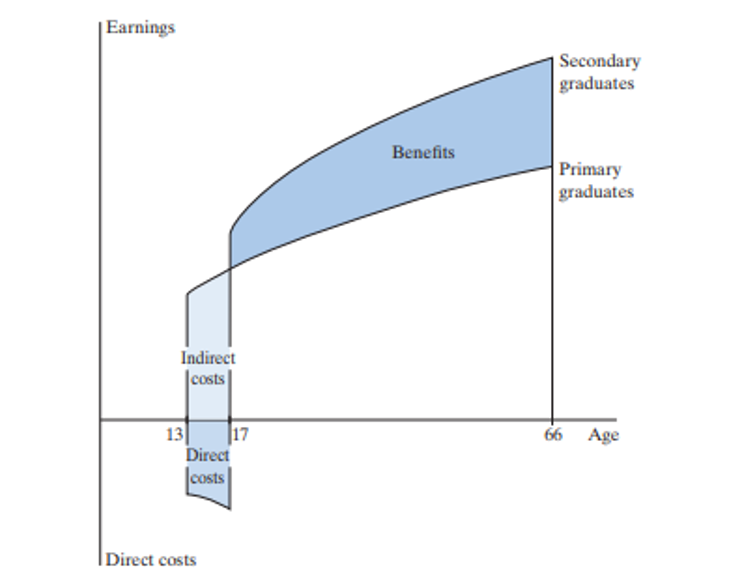
- Suppose that the individual works from the time he finishes school until he retires, which is taken to be 66 years.
- The primary school graduate starts earning at the age of 13, beginning work immediately after primary school.
- Secondary school graduates start earning at the age of 17, four years after primary school graduates.
Costs of Higher Education
Those individuals who opt for secondary education have to face two types of costs, direct and indirect.
- Direct cost includes tuition fees and other expenses related to education during the secondary school years.
- Indirect cost includes the foregone income of 4 years, the earnings they could have made if they had worked instead.
The individual who opt work after primary education neither have to face direct cost of tuition fees nor indirect cost of forgone income.
Benefits of Higher Education
After secondary school education, 17-year-old individuals earn a lifetime income that is more than that of individuals who have a primary education and started working at the age of 13.
These are the benefits of higher education, which are labelled as blue. The additional lifetime earnings of the secondary school graduate over the primary graduate represent the net returns to investing in secondary education.
Human Capital Theory
Human capital theory treats education as an investment in people, increasing their productivity and earning capacity. Human capital refers to the productive investments in human beings, including expenditure on health, education, skills, and abilities, which raise their productivity and earnings.
Human Capital Earnings Function
The human capital earnings function estimates the effect of investments in human capital, such as education, experience, trainings on wages and economic outcomes. Jacob Mincer formalised human capital theory as an empirical earnings function.
Mincerian Earnings Function
The Mincerian Earnings Function explains the relationship between an individual’s education, experience, and earnings. According to this model, the log of earnings depends on years of schooling (S), years of work experience (X), and the square of years of work experience.

Explanation and Interpretation of Mincerian Earnings Function
- Natural log of earnings [(lnWagei)]: Taking the natural logarithm of earnings helps to linearise the relationship between earnings and the explanatory variables, making it easier to estimate using a linear regression model.
- Years of Schooling (Si): This variable captures the effect of formal education on earnings. The coefficient β₁ measures the rate of returns to education, and it represents the percentage increase in earnings associated with an additional year of schooling.
- Years of Experience (Xi): Work experience is another critical factor affecting earnings. The coefficient β2 measures the percentage increase in earnings for each additional year of work experience.
- Squared Term of Experience (Xi²): The inclusion of the squared term allows for the modelling of diminishing returns to experience. The coefficient β3 captures this non-linear relationship.
- Error term (u_i): This term captures the effect of unobserved factors on the log of wages that are not included in the model.
Extensions of Mincerian Earnings Function
The Mincerian Earnings Function can be extended to include other variables such as gender dummies for gender wage differential, regional dummies for regional wage differential, etc.
The extended Mincerian earnings function can be written as:

Explanation and Interpretation of Extended Mincerian Earnings Function
- Gender Dummy Variable (Gi): Captures the gender wage gap, the difference in earnings between male and female workers with the same education and experience level. β4 measures this gender wage difference
- Regional Dummy Variable (Ri): Captures the region-wage gap, urban vs. rural differentials, and provincial differences, etc. β5 measures this region wage difference
Other Possible Extensions;
Occupation type, industry sector, firm size, public vs. private sector employment, ethnicity, language, social networks.
Suggestions for further readings:
