

Introduction to Demographic Transition Theory
Demographic Transition Theory (DTT) explains how population growth changes as countries move from traditional agrarian economies to modern industrial societies. The theory highlights long-term shifts in birth rates, death rates, and population growth, showing that development transforms population dynamics over time.
Early societies experienced high birth and death rates, which kept population growth low and unstable. However, with industrialization, improvements in healthcare, sanitation, nutrition, and living standards reduced mortality rates. Eventually, fertility rates also declined due to urbanization, education, and economic changes, causing population growth to slow and stabilize.
The theory was developed in the early 20th century by demographers such as Frank W. Notestein and Warren Thompson.
Does increasing population good or bad?
Population growth has both advantages and disadvantages, and its impact depends largely on the quality of human capital and economic capacity.
Advantages of Population Growth
- Provides a large labor force for production and economic growth
- Creates a bigger domestic market for goods and services
- Encourages innovation, creativity, and technological progress
- Promotes investment in education, healthcare, and skill development, leading to stronger human capital
Disadvantages of Population Growth
- Increases pressure on natural resources
- Leads to unemployment and underemployment if jobs are insufficient
- Causes environmental degradation and pollution
- If economic growth is slower than population growth, per-capita income declines
Conclusion: Population size alone does not determine prosperity. A skilled, educated, and productive population is a major economic asset.
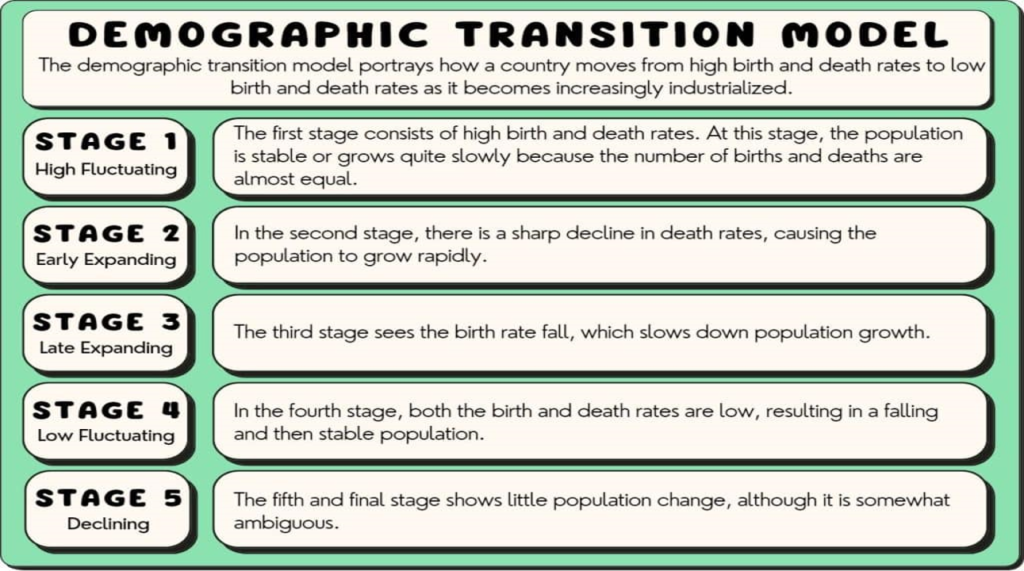
Stages of Demographic Transition Theory
Demography is the scientific study of human populations. Demographic Transition Theory suggests that societies pass through different stages characterized by changes in birth and death rates.
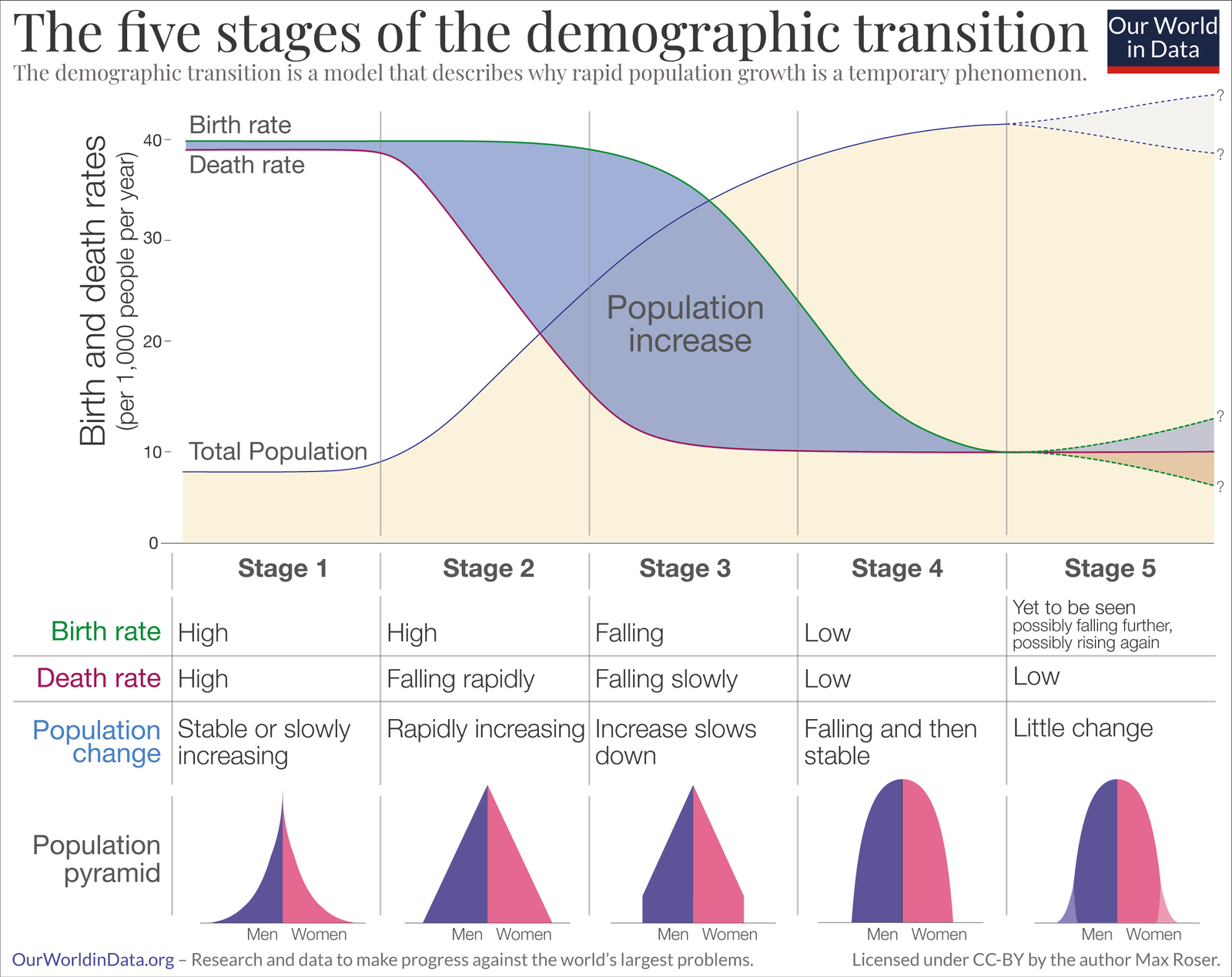
Figure 1: Stages of Demographic Transition
Demographic Transition in Developed Countries
Stage 1: High Fluctuating Stage
Also known as pre-industrial or pre-transitional stage.
Characteristics:
- High birth rates due to lack of contraception and agrarian economy
- High death rates caused by disease, famine, and poor sanitation
- Low life expectancy
- Stable of slow growing population
Example: Most societies before the 18th century
Stage 2: Early Expending Stage
Also known as transitional stage.
Characteristics:
- High population growth rate
- Death rates fall rapidly due to healthcare improvements and better nutrition
- Birth rates remain high
- Agricultural and technological progress increases food supply
- Population becomes youthful
- Growth rate rises (around 1% or more)
Example: Western Europe during the Agricultural Revolution
Stage 3: Late Expanding Stage
Also known as industrial or late transition stage
Characteristics:
- Birth rates decline due to urbanization and higher income
- Fertility falls with female education and employment
- Family planning becomes common
Examples: Malaysia, Mexico, Saudi Arabia
Stage 4: Low Fluctuating Stage
Also known as post-industrial or post transitional stage
Characteristics:
- Low birth and death rates
- High life expectancy
- Aging population
- Population stabilizes
Examples: Bangladesh, Argentina, India
Stage 5: Declining Population
Characteristics:
- Fertility falls below replacement level
- Population begins to shrink
- Aging society and labor shortages
- This stage ambiguous
Examples: Japan, Italy, Germany
Conclusion
Western Europe experienced the full demographic transition by the second half of the 20th century. Birth rates declined significantly while death rates stabilized or slightly increased due to population aging. This created a shift from rapid growth to stable or declining populations. Thus,
Demographic transition process implies movement from stable population growth rates with high birth and death rates to higher population growth with declining death rates and to slower or no population growth.
Demographic Transition in Developing Countries
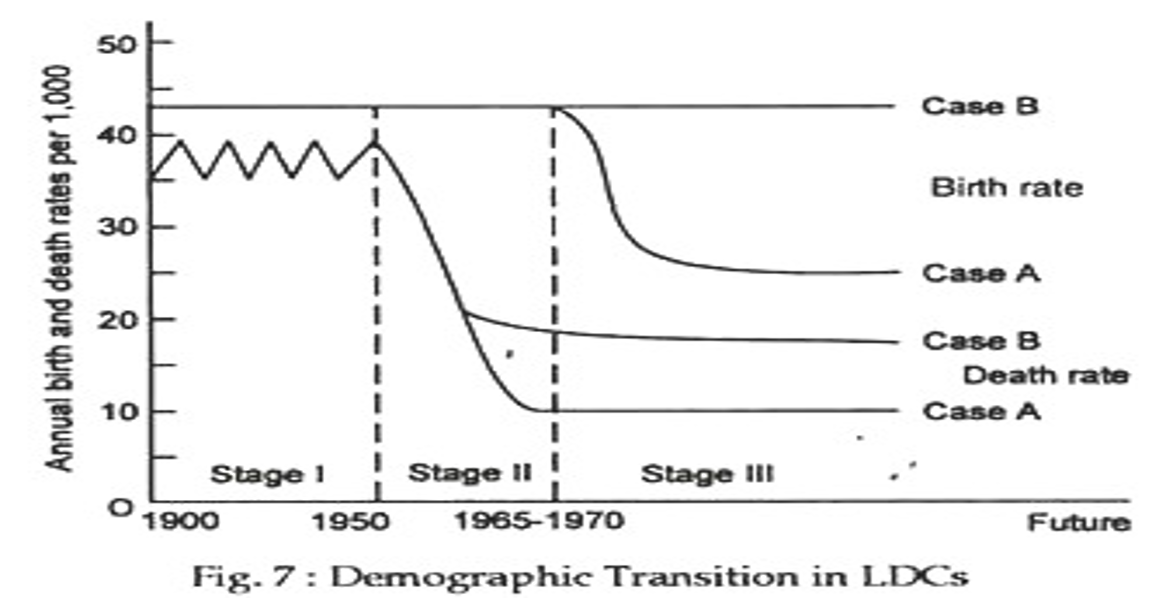
In developing countries, birth rates were higher than those in pre-industrial Western Europe due to earlier marriages, leading to more families and longer childbearing periods. This resulted in population growth rates exceeding 2% per annum.
During the 1950s and 1960s, stage 2 of the demographic transition occurred in most developing nations, with death rates falling rapidly due to the adoption of modern medical and public health technologies.
In third stage there are two broad classes of LDCs. In case A there are countries where birth rate is between 20 to 30 per 1000 and have a stable or low population growth. These countries include Srilanka Philippines, South Korea, China, Mexico, Thailand, Indonesia. These countries have entered stage-III.
In case B there are countries such as Middle East, Sub-Saharan Africa and some Asian countries like India which are still in stage-II. In these countries death rate is around 20 and birth rate does not decline due to low living standard.
Summary
Demographic transition describes the transformation of population growth patterns from:
- High birth and death rates with low growth
- Falling death rates with rapid growth
- Declining birth rates with stable or slow growth
Ultimately, the process leads to low birth and death rates and stable or declining population growth.
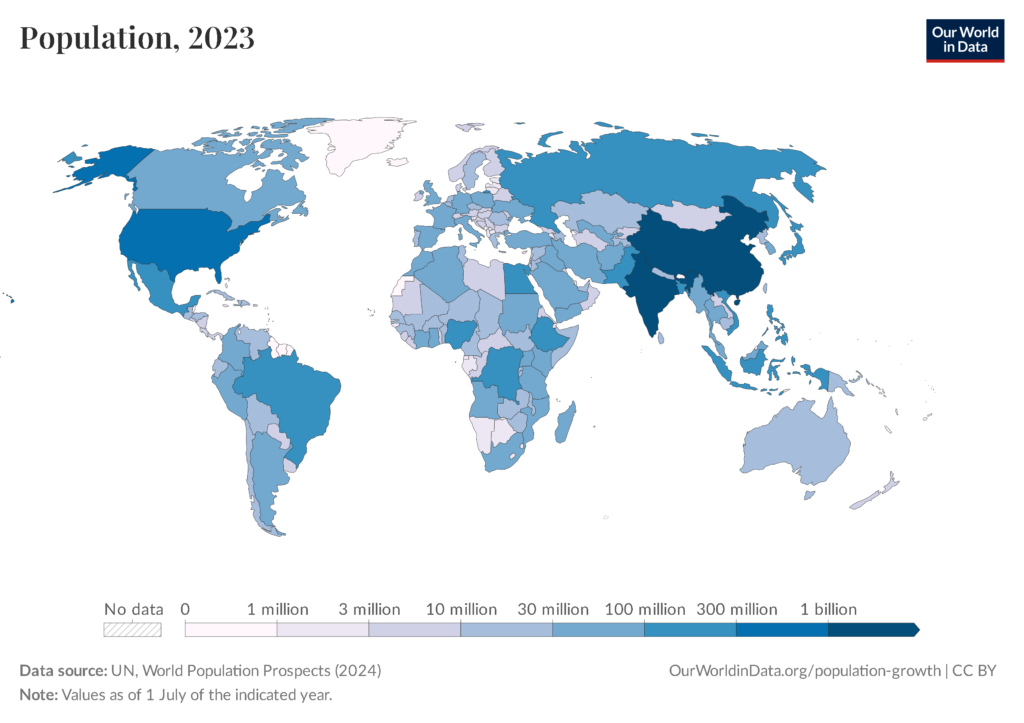
World Population Map
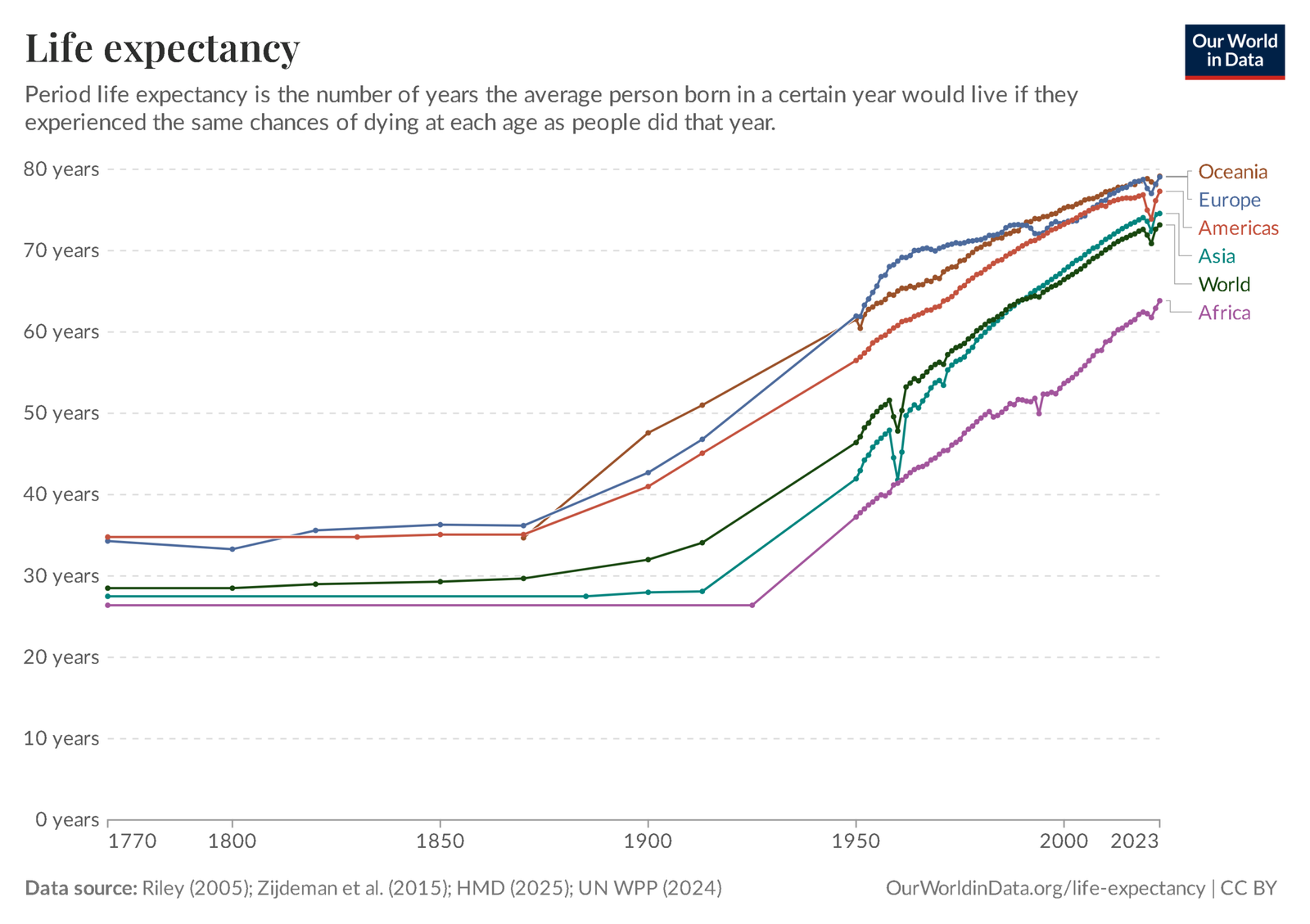
Life Expectancy Over Years
Suggestions for further reading


 MinhajMetricsHub
3 responses to “Demographic Transition Theory”
[…] Demographic Transition Theory […]
[…] 3rd stage of Demographic Transition Theory marks the decline of birth rate with the increase in level of economic development. To explain […]
Перебирала варіанти, де взяти постільну білизну, рушники, пледи чи штори, аби тканина тішила, шви акуратні, а ціна розумна. Переглянула кілька інтернет-магазинів і натрапила на один тлумачний проєкт. Вибір радує — від простої бязі до турецького люксу, не забули і про кухню, і про ванну. На сайті hometextiles.com.ua Швидка доставка по Україні, без проблемний повернення і плюс часто ловляться гарні знижки по промокодах.