

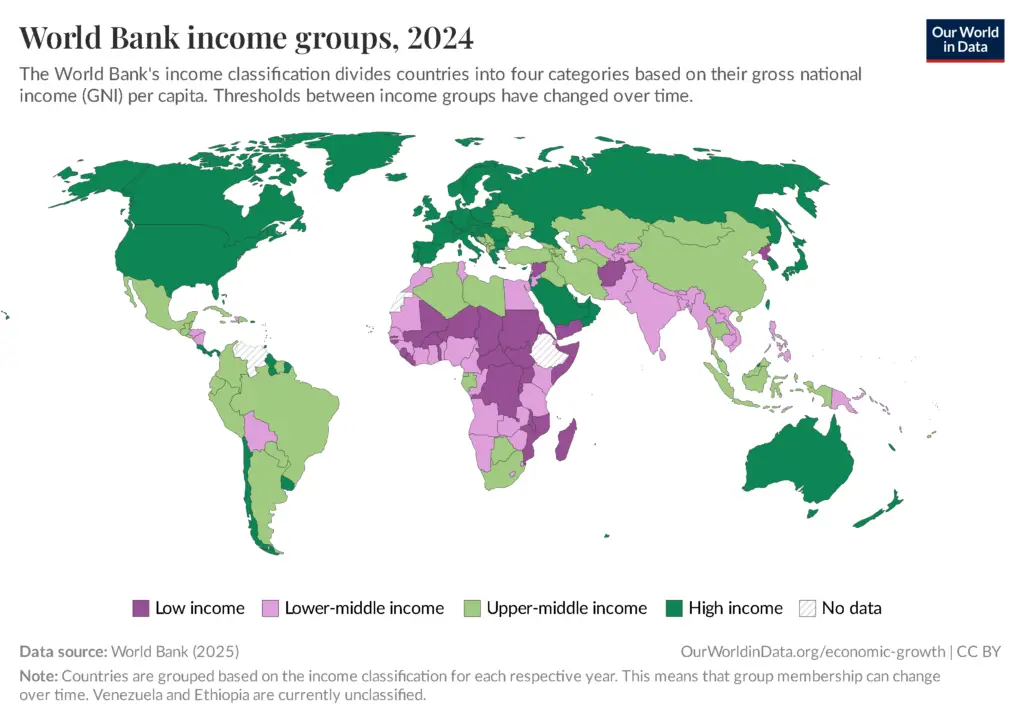
Countries are often classified by levels of income and human development. They are also grouped by levels of poverty, quality of governance, and many other dimensions. The most common way to compare countries is to compare their average income that is Gross National Income Per Capita. The World Bank classifies countries according to Gross National Income per-capita into four groups:
- Low-income countries (LICs)
- Lower-middle-income countries (LMCs)
- Upper middle-income countries (UMCs)
- High-income countries (HIC)
World Bank Classification of Countries
World Bank is an international financial institution that provides development funds to developing countries in the form of interest-bearing loans, grants, and technical assistance. Low-income countries (LICs) In the World Bank classification, countries with a GNI per capita  1,136 and
  4,496 and
  13,935 in 2025.
What are Least Developed Countries?
Least Developed Countries (LDCs): A country that has three characteristics are named as least developed countries: These are:
- Low income
- Low human capital (low health and education)
- High economic vulnerability
Characteristics of Least Developed Countries
Low level of Income and Productivity
There is a large productivity difference between advanced economies such as the United States and the developing nations. It is due to the large gaps in output per worker. Developing countries often face a vicious circle of poverty due to lack of productivity, income and capital.
Low Level of Human Capital
The least developed countries have lower levels of nutrition, health, and education. According to UNDP human development report 2023-24 HDI of LDCs is 0.542 and most developed countries have HDI value 0.8 or above.
High Level of Inequality and Poverty
Very high levels of inequality and absolute poverty are found in many low-and-middle income countries due to low productivity, low-income level and lower level of human capital.
High Population Growth
Low-income and middle-income countries are characterized by high population growth rate. According to UN World Population Prospects 2024 population growth in low income and middle-income countries is 2.7% and 0.7% respectively as compared to high income countries which is 0.4%.
Rural Economy
In most low- and many middle-income countries, a high share of the population lives in rural areas. It is estimated that in 2023, about 65% of population in low-income countries live in rural areas as compared to less than 20% in high-income countries.
Social Fractionalization
Low-income countries more often have ethnic, linguistic, religious, and other forms of social divisions, called “fractionalization”. It leads to social conflicts, political instability, and low economic growth.
Low Level of Industrialization
Developing countries have low levels of Industrialization. They have a higher share of employment and output in the agricultural sector. In developing countries more than two-thirds of the population works in agriculture as opposed to 1% to 2% in U.S, Canada and U K.
Geographical Location
Most of the developing countries are primarily tropical or subtropical, these countries often suffer from tropical pests and parasites, epidemic diseases such as malaria, water resource constraints, and extremes of heat.
Natural Resource Endowments
High income countries are often rich in natural resources such as gulf countries are oil rich. On the other hand, there are countries such as Chad, Yemen, and Haiti, where the raw materials, minerals and fertile land are relatively minimal.
Underdeveloped Markets
Developing countries have imperfect markets and incomplete information. These countries have a lack of legal system, infrastructure, stable currency, market information and social norms.
Colonial Legacy
Most developing countries were once colonies of Europe. Stolen resources is one reason why these countries are still underdeveloped.
External Dependence
Developing countries are mostly dependent on developed countries in the form of grants, foreign aid, technology and environmental preservation.


 MinhajMetricsHub