


In this post we will discuss what is project appraisal, importance and aspects of project appraisal with examples.
What is Project Appraisal
Definition
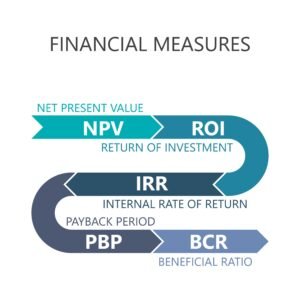
Project appraisal is the systematic evaluation of a proposed project to determine its feasibility, viability, and potential for success before committing resources to its implementation. Some of the common project appraisal techniques are NPV, IRR, BCR etc.
Explanation of Project Appraisal
With scarce resources in hand an entrepreneur needs to appraise alternative projects before allocating the resources for the best project. Thus, project appraisal helps select the best project among available alternative projects. For appraising a project its economic, financial, technical, market, managerial, environmental and social aspect are analyzed.
Project appraisal is made for both proposed and executed projects. Appraisal for a proposed project before it is started, is called ex-ante appraisal and appraisal of a completed project, is called ex-post appraisal.
Here, project appraisal is related to a proposed project. Project appraisal is a cost and benefits analysis of different aspects of a proposed project with an objective to assess its viability. OR Project appraisal means a pre-investment analysis of project to determine whether the project should be implemented or not.
Importance
- Assessment of project in terms of its social, financial and economic viability.
- Decide, whether to accept or reject a project.
- To select the best project among available alternative projects.
- It is useful to assess the number of resources needed to complete the project.
- Identifying potential problems and risks before project implementation.
- To ensure efficient allocation of limited resources.
Limitations
- The quality of project analysis depends on the quality of data. Overestimation or underestimation of costs and benefits may result in the approval of projects that are not viable.
- Future market conditions, economic policies, and unforeseen circumstances can affect the validity of the appraisal results.
- Benefits such as social welfare or environmental impact can be challenging to quantify accurately.
Aspects of Project Appraisal
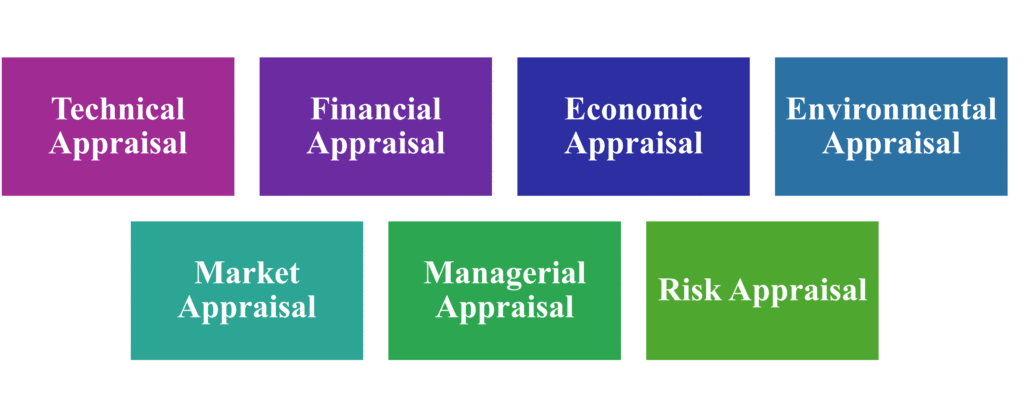
- Technical Appraisal
- Financial Appraisal
- Economic Appraisal
- Environmental Appraisal
- Market Appraisal
- Managerial Appraisal
- Risk Appraisal
Now we explain each aspect of project appraisal in detail with an example of a bridge construction project.
Technical Appraisal
Technical appraisal assess the engineering feasibility of the project including its design, technology requirements, resource availability and potential risks. This aspect ensures
- Availability of land and site.
- Availability of required raw material and tools as per quality and quantity
- Availability of skilled workforce.
- Availability of required technology
Example: In case of a bridge construction, technical appraisal would involve examining the geographical location, type of construction materials, strength of the proposed design and evaluating potential challenges, such as the river’s width, depth, and flow rate.
Financial Appraisal
Financial appraisal assess the financial viability of the project. It involves estimating the project costs as well as expected cash flows of the project. Financial projections such as the Net Present Value (NPV), Internal Rate of Return (IRR), Payback Period and Profitability Index (PI) are calculated to determine if the project is financially feasible.
The costs include.
- Capital cost like land and raw material acquisition, labor and engineers’ wages, equipment and machinery.
- Operating costs such as maintenance and repair cost, administrative cost and insurance costs.
Economic Appraisal
Economic appraisal considers the broader economic impacts of the project to the whole economy. It focus on the total benefit of the project on society and economy. It examines the project contribution to economic growth, employment, living standard, income distribution, govt. revenue, overall welfare and positive and negative externalities of the project.
Cost-Benefit Analysis (CBA) is the most widely used technique in economic appraisal which compares total benefits with the total costs in monetary terms.
For example, a bridge might reduce transportation costs, reduced travel time, improved trade, decrease congestion, and improve access to services, thereby stimulating economic activity in the region.
Environmental Appraisal
Environmental appraisal assesses the potential impact of a project on environment and ecosystem throughout its lifecycle and ensures that it aligns with environmental regulations and sustainability goals. Environmental Impact Assessment (EIA) is a common tool used for environmental appraisal.
Example: In the case of a bridge project, environmental appraisal would involve studying the impact of the bridge on the surrounding ecosystem, such as rivers, forests, and wildlife. This also includes mitigation measures to minimize negative effects, such as pollution, habitat destruction, and resource depletion.
Market Appraisal
Market appraisal analyzes the demand for the services provided by the project. Market appraisal considers the following things:
- What would be the aggregate demand for the product or service?
- What would be the market share of the proposed project?
- Past and current demand and supply trends
- Imports and exports
- Nature of competition
- Cost structure
- Elasticity and demand of consumer behavior, attitudes, preferences and requirements.
- Distribution channels marketing policies.
Managerial Appraisal
Managerial appraisal asses the management and organizational aspect of the project. It evaluates the ability of management team to effectively plan, execute and complete a project within given resources and timeline.
Management ability plays an important role in making a project successful. In the absence of managerial competence, the projects may fail. On the contrary, even a poor project may become a successful one with good managerial ability.
Example: In a bridge project this includes assessing the expertise of the engineers, architects, project managers, and contractors involved.
Risk Appraisal
Risk appraisal identifies and evaluates the potential risks associated with the project and proposes strategies to mitigate them. It involves analyzing both internal and external risks, including financial risks, operational risks, political risks, and environmental uncertainties.
For example, for a bridge project, risk appraisal might involve assessing the likelihood of natural disasters (e.g., floods), project delays due to technical challenges, and devising strategies to address these risks.
Suggestions for further reading:
- What is Project, Its Types, Dimensions and Project Life Cycle
- Project Appraisal: How to Measure the Value of Projects – Project Manager




 MinhajMetricsHub
One response to “Project Appraisal: Meaning, Importance and Major Aspects with Example”
[…] project appraisal, its objectives and various aspects of project appraisal which can accessed at Project Appraisal: Meaning, Importance and Major Aspects with Example. In this post we study different categories of project benefits and project […]