

Short Questions
- Absolute poverty is the situation of being unable or only barely able to meet the basic needs of life such as food, clothing, shelter, and basic health care. According to World Bank, nowadays global poverty line is 3 USD per person per day.
- Absolute poverty line is used to measure poverty in a country. It is the minimum level of income required to meet the subsistence essentials of food, clothing, and shelter. Nowadays, the international poverty line is 3 USD per person per day.
- Brain drain is the emigration of highly educated and skilled professionals and technicians from developing countries to the developed world in search of better job opportunities and living conditions.
- Capital-output ratio (K/Y) shows the amount of capital required to produce one unit of output. It is denoted by c. Thus, c=K/Y. In the Harrod-Domar growth model, it is an important determinant of economic growth.
- Debt servicing is the process of making regular payments on a debt, which includes both interest payments and the repayment of the principal amount to the creditor.
- Development economics is the subfield of economics that studies how economies are transformed from stagnation to growth and from low income to high income status and how they overcome the problem of absolute poverty.
- Economic development can be defined as a process where an increase in per capita income or output also leads to improvements in the living standards of the whole population, reductions in poverty, unemployment, and inequality, increased access to basic needs, and increased employment opportunities and choices.
- Economic growth is the rise in an economy’s output of goods and services over time. It is typically measured by the growth rate of GNP per capita.
 .
. - Economic infrastructure refers to the foundational physical and financial capital necessary for economic activities. It includes assets like communication assets, water supplies, financial institutions, electricity, and public services such as health and education.
- Globalization is the increasing integration of national economies in the international markets through international trade, technology transfer, labor mobility etc.
- Human capital refers to productive investments in people, such as skills, education, and health resulting from expenditures on education, on-the-job training programs, and medical care.
- Human Development Index (HDI) is a composite index to measure socio-economic development of a country. It was introduced by UNDP in 1990. It has three dimensions: long and healthy life, knowledge, and living standard. It ranges from 0 to 1.
- Industrialization refers to the process by which an economy transforms from primary agriculture to industrial sector. It involves the growth and expansion of industries, technological advancements, urbanization.
- Informal economy refers to economic activities that are not monitored or regulated by the government. It includes small scale business, home based work, street vendors etc.
- Least Developed Countries (LDCs): A country that has three characteristics are named as least developed countries: low income, low human capital (health and education), and high economic vulnerability.
- Life expectancy is defined as the average number of years a person is expected to live based on current mortality rates. It is a key indicator used to measure health and well-being used in HDI.
- Physical Quality of Life Index (PQLI) is a measure of socio-economic development invented by M.D. Morris in 1979. He constructed a composite index by combining three indicators of infant mortality, life expectancy at age one and basic literacy at age 15. It ranges from 0 to 100.
- Subsistence economy is an economy in which production is done mainly for personal consumption to meet their own needs rather than for trade or profit.
- Subsistence farming refers to crop production and livestock rearing conducted mainly for personal consumption with little or no surplus for sale.
- Subsistence wage refers to the minimum income necessary for a worker to meet their basic needs of food, clothing, shelter and basic healthcare. In Lewis model subsistence wages are determined by average product of labor which are well below urban wages.
- Surplus labor refers to the labor whose marginal productivity is zero. If we withdraw this labor from agri. sector and employ in modern sector, then there is no effect on agri. output since MPL is zero.
- Underdevelopment is an economic situation characterized by low level of living, low per capita income, absolute poverty, poor health services, high death rates, high birth rates etc.
- Urbanization refers to the process by which a country’s population moves from rural areas to urban areas, leading to the growth and expansion of cities and towns. Its major causes include job opportunities, better education and healthcare etc.
- Vicious circle of poverty is a self-perpetuating cycle where low-income families or countries remain trapped in poverty, which transfers across generations. Here is how it works: Low Income → Low Savings → Low Investment → Low Productivity → Low Income.
- Structural change: It occurs when the share of manufacturing sector in national income surpasses the share of the agricultural sector. Example: Lewis model of economic development, where transfer of surplus labor increases industrial sector output.
- International dependence models view that developing have failed to develop because they are trapped in a cycle of dependence and dominance of developed countries. These models include neocolonial dependence, false paradigm and dualistic development model.
- Neocolonial dependence model explains how former colonies remain economically dependent on developed nations through trade imbalances, foreign aid, and the influence of multinational corporations.
- False-paradigm model states that developing countries have failed to develop because their development policies are often designed by Western economists These strategies are unsuitable for developing countries because they neglect the social, institutional, and cultural factors
- Dualistic development thesis suggests that developing countries are divided into two opposite situations in which one is desirable and other is not. For example, extreme poverty and affluence, modern and traditional economic sectors, growth and stagnation, higher education to few and illiteracy at large.
- Absolute advantage refers to the ability of a country to produce goods and services with greater efficiency i.e., with lower costs than the other country. For example, Brazil has absolute advantage in producing coffee, and Middle East in oil production.
- Balance of payments is a record of all the economic transactions between households, firms, and the government of one country and the rest of the world. It includes transactions of visible as well as invisible items, unilateral transfers and capital transfers.
- Balance of Trade (BOT) is the difference between value of exports ( ) and imports ( ) of physical goods only during a specific year. . If there is trade surplus, if there is trade deficit, if there is balanced trade.
- Balanced growth is an economic development strategy that advocates simultaneous and proportional investment in all sectors of the economy. Unbalanced growth refers to an economic development strategy that advocates investment in specific key sectors that have the potential to drive overall economic growth.
- Bilateral aid is financial assistance given directly by one country to another. This aid includes only one recipient and one donor. Bilateral aid can be in the form of loans, grants and technical assistance.
- BNA indicator refers to the Basic Needs Approach indicator, which measures how well basic human needs (food, shelter, education, healthcare) are met in a population. Some BNA indicators are HDI, PQLI, MPI.
- Capital-labour ratio (K/L) also known as capital per worker represents the amount of capital that each worker has in production of goods and services. The more capital with each worker has, the more output that worker can produce.
- Commodity terms of trade is the ratio of a country’s average export price to its average import price. It includes the trade of commodities only like raw material, agricultural products etc.
 .
. - Comparative advantage refers to the ability of a country to produce a particular good or service at a lower opportunity cost than its trading partners. This theory was developed by David Ricardo.
- Convergence is the tendency for per capita income to grow faster in lower-income countries than in higher-income countries so that lower-income countries are “catching up” over time.
- Corporate farming refers to the large-scale agriculture production owned and operated by large corporations for the purpose of maximizing profit. This type of farming often uses modern technology, fertilizers, hired labor etc.
- Debt servicing is the process of making regular payments on a debt, which includes both interest payments and the repayment of the principal amount to the creditor.
- Disguised unemployment refers to a situation where more people are employed than actually needed. If we withdraw this surplus, the total labor output does not fall because their marginal productivity is zero.
- Divergence is a tendency for per capita income to grow faster in higher-income countries than in lower-income countries so that the income gap widens across countries over time.
- Foster-Greer-Thorbecke (FGT) measure is a family of poverty indices that is used to assess the depth and severity of poverty based on income or consumption shortfall relative to predefined poverty line.
- Free trade refers to the import and export of goods and services without any trade barriers such as tariffs, quotas, subsidies and other restrictions to promoting efficiency, competition, and economic growth.
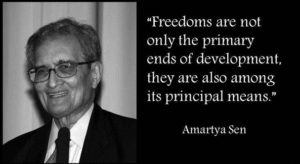
- Freedom from servitude refers to the ability to make choices and have control over one’s life. Freedom also means i. Availability of more goods and services, ii. Political freedom and participation, iii. Economic freedom, iv. Rule of law, v. Equality of opportunities, vi. Personal security.
- General Agreement on Tariffs and Trade (GATT) was a multilateral trade agreement among countries aimed at promoting free trade by reducing tariffs, quotas, and other trade barriers. It was established in 1947 and was replaced by WTO in 1995.
- Green revolution is the large increase in production of food grains especially wheat and rice in developing countries, achieved by using modern agricultural techniques, fertilizers, pesticides and high yielding varieties (HYV. It is also called the Third Agricultural Revolution.
- Import substitution is a development strategy that aims to reduce dependency on imports by promoting domestic production of goods and services. Its aim is to protect domestic industries from foreign competition.
- Income distribution means how a nation’s total GDP is distributed amongst its population. It’s a measure of economic equality/inequality. To most commonly used measures of inequality are Lorenz curve and Gini coefficient.
- Income inequality refers to the uneven distribution of total national income among households or income groups. It is measured by Lorenz curve, Gini coefficient, Kuznets ratio etc.
- Industrialization refers to the process by which an economy transforms from primary agriculture to industrial sector. It involves the growth and expansion of industries, technological advancements, urbanization.
- Kuznets hypothesis or Kuznets curve shows the inverted-U shaped relationship between income per capita of a country and income inequality. At early stages of economic growth, income inequality increases, after reaching a maximum point inequality starts to decline.
- Land tenure system refers to the set of rules, policies, and practices that determine how land is owned, used, and managed within a society. Different types of land tenure systems are private tenure, communal tenure, state tenure and customary tenure.
- Market failure is a phenomenon that results from the existence of market imperfections (e.g., monopoly power, lack of factor mobility, externalities) that weaken the functioning of a market economy.
- Market Imperfection is the situation where the assumptions of perfect competition are not met, leading to inefficiencies in the allocation of resources. Different types of market imperfections include externalities, asymmetric information, barriers to entry, imperfect factor mobility, monopoly and oligopoly.
- Millennium Development Goals (MDGs) are the set of eight goals adopted by United nations in 2000 to be achieved by 2015. These goals include eradication of global poverty, hunger, disease, illiteracy and achieve other human development goals.
- Output-Labor ratio (Y/L) or output per worker is the amount of output produced by a unit of labor. It is also known as average product of labor (APL). It is a measure of productivity and efficiency of labor.
- Per capita income refers to the average income that each person earns in an economy in a year. It is the measure of average living standard. It is calculated by dividing national income by total population. 𝑃𝐶𝐼 = 𝑁𝐼/𝑇𝑜𝑡𝑎𝑙 𝑝𝑜𝑝𝑢𝑙𝑎𝑡𝑖𝑜𝑛.
- Purchasing power parity (PPP) refers to the calculation of GNI using a common set of international prices for all goods and services, to provide more accurate comparisons of living standards across countries.
- Relative poverty refers to a situation in which an individual`s income falls below a certain percentage of the median national income. It indicates living standard of an individual relative to others in society.
- Restricted trade is a protectionist policy in which the government limits imports and exports of goods and services using trade barriers such as tariffs, quotas, subsidies, and other restrictions to protect domestic industries from foreign competition.
- Self-esteem is concerned with the feeling of self-respect and independence. It also refers to having life-sustaining basic needs met without feeling disgrace or relying on others.
- Self-sustaining growth refers to the economic growth that continues over the long term based on saving, investment, and complementary private and public activities.
- Sharecropping is an agricultural system where a landowner allows a tenant to use their land for farming in return for a share of the crops produced. Thus, it involves landowner who provide capital and tenants who provide labor and output is shared on pre-agreed percentage.
- Surplus labor refers to the labor whose marginal productivity is zero. If we withdraw this labor from agri. sector and employ in modern sector, then there is no effect on agri. output since MPL is zero.
- Sustainable Development Goals (SDGs) are set of 17 global goals adopted by the UN member countries in September 2015 to be achieved by 2030 aiming to eradicate multidimensional poverty and improvement in quality of life.
- Sustenance in development is the ability to meet life sustaining basic needs like food, clothing, shelter, health and protection. It is the minimum level required for a good life. It involves eradicating poverty, hunger and disease.
- Technical progress refers to the improvement in technology that increases the efficiency of production processes, enables firms to produce more output using the same or fewer input.
- Terms of trade refer to the ratio of country’s export price index to import price index. It measures how much imports a country can buy for one unit of its exports. .
- Tied aid refers to financial assistance that comes with certain conditions such as purchasing goods or services from the donor country. This aid can benefit the donor country by boosting its own exports.
- Trickle-Down Effect (or Trickle-Down Theory) is an economic concept that suggests the benefits of economic growth and wealth creation at the top levels of society eventually “trickle down” to the lower-income groups.
- Untied aid refers to financial assistance that comes without any conditions. Therefore, untied aid provides more flexibility and freedom to the recipient country. This type of aid is generally more advantageous for the recipient country.
- World Trade Organization (WTO) is an international organization that promotes free trade, sets rules for global trade and resolves trade disputes among nations. It was established in 1995 by replacing GATT. The WTO headquarters is in Geneva.
- Life expectancy is defined as the average number of years a person is expected to live based on current mortality rates. It is a key indicator used to measure health and well-being used in HDI.
- Endogenous growth models (new growth models) state that economic growth is determined by internal factors such as human capital, knowledge, skill learning, and innovation. Such as Arrow model, Romer model etc.
- Exogenous growth models state that economic growth is determined by exogenous factors such as technological progress, population growth, saving ratio, and capital-output ratio etc. Such as Solow Growth Model, Harrod-Domar Growth Model etc.
 .
. .
.



 MinhajMetricsHub