

In the previous couple of posts we learned about what a project is, it’s different types, project dimensions, project life cycle which you can access at What is Project, Its Types, Dimensions and Project Life Cycle. Moreover, we have also discussed what is project appraisal, its objectives and various aspects of project appraisal which can accessed at Project Appraisal: Meaning, Importance and Major Aspects with Example. In this post we study different categories of project benefits and project costs.
Economic Benefits and Costs of Projects
Economic Benefits
An economic benefit is any gain that we can quantify in terms of the money. Net income and revenues are the examples of economic benefit. An economic benefit may also refer to a reduction in something such as a cost. For example, lower raw materials or labour costs are economic benefits. Economic benefits can be direct and indirect.
Direct Economic Benefit
Direct benefits are the primary, measurable outcomes that result immediately from the project’s implementation and can typically be quantified in monetary terms for example: increased revenue or sales, reduced costs, improved efficiency or productivity, time saved etc.
Indirect Economic Benefit
Indirect benefits are the secondary or spillover positive outcomes that occur as a consequence of a project. For example: tax revenue, increased customer satisfaction, greater market share, reduced environmental impact, increased property values, infrastructure improvements, company reputation or increased customer loyalty etc.
Economic Costs
Economic costs are the direct financial expenditures and opportunity costs associated with implementing a project. In other words, it is the total value of all resources used in the project including both explicit monetary expenses and opportunity costs.
Example: For a highway construction project, the economic cost includes the cost of using materials, labor, machinery, land acquisition, plus the opportunity cost of the land and labor that could have been employed in other productive activities.
Direct Economic Cost
Direct costs are those expenses that are tied directly to a project that can be easily quantified. For example: Materials and supplies, labor costs, equipment purchases or rentals, software or technology expenses, marketing or advertising costs.
Indirect Economic Cost
Indirect costs are the expenses that are not directly tied to a specific project but are necessary for the organization’s overall operations. For example: administrative cost (salaries of administrative staff), utilities (electricity, water, etc.), rent or mortgage payments for facilities, insurance costs, IT support etc.
Net Economic Benefits
Net economic benefit is the difference between total economic benefits (direct and indirect) and total economic costs (direct and indirect). Net benefits are commonly used in cost-benefit analysis to determine whether a project should be funded.
Net Benefits=Total Benefits-Total Costs
Total Benefits=Direct Benefits + Indirect Benefits
Total Costs=Direct Costs + Indirect Costs
Social Benefits and Social Costs
Social Benefits
Social Benefits are total benefits including private benefits gained by individuals or organizations directly involved in an activity and the external benefits gained by the third parties not directly involved in an activity.
Social Benefits=Private Benefits + External Benefits
Social Costs
Social Costs are total costs including private costs borne by individuals or organizations directly involved in an activity and external costs borne by the third parties not directly involved in an activity.
Social Costs=Private Costs + External Costs
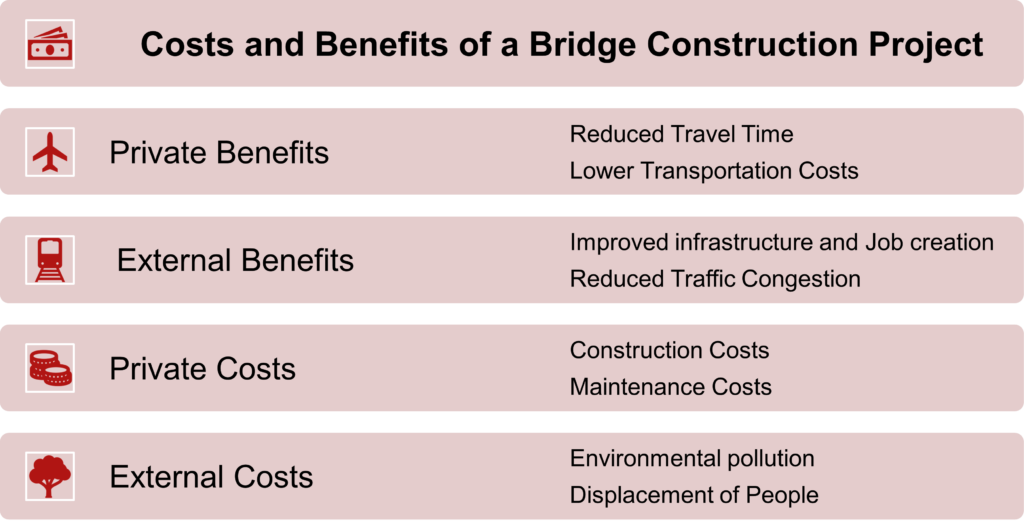
An example will clarify how private and external benefits and costs are differ. Consider the costs and benefits of a bridge construction project.
- Private Benefits
- Reduced Travel Time
- Lower Transportation Costs
- External Benefits
- Improved infrastructure and Job creation
- Reduced Traffic Congestion
- Private Costs
- Construction Costs
- Maintenance Costs
- External Costs
- Environmental pollution
- Displacement of People
Measuring the Economic Benefits
- Net Cash Flow
- Wealth creation
- GDP growth rate
- Revenue
Net Cash Flow
Cash flow refers to the movement of money into and out of a business, project, or individual’s account over a specific period. Cash inflow is the amount of money coming into the business from various sources during a specific period such as revenue from sales of goods or services and interest earned on investments. Cash outflow is the amount of money going out of the business during a specific period such as payments for salaries, rent, or utilities, purchase of inventory, raw materials, or equipment, loan repayments or interest payments, taxes or dividends paid.
Net cash flow is the difference between cash inflows and cash outflows. It is the net amount of cash that a business or an individual has on hand after accounting for all incoming and outgoing cash transactions during a specific period such as a month, quarter or year. Positive net cash flow occurs when a business or individual has more cash coming in than going out. Negative net cash flow occurs when a business or individual has more cash going out than coming in. Positive net cash flow is generally seen as a sign of financial health as it indicates that a business or individual has enough cash to cover its expenses.
Net Cash Flow = Total Cash Inflows – Total Cash Outflows
Wealth Creation
Wealth creation for a firm refers to the process of increasing the value of the firm’s assets and generating profits over time. This can be achieved by:
- Increasing revenues through higher sales.
- Better pricing strategies.
- Reducing costs by improving efficiency.
- Expanding into new markets.
- Innovating products or services to meet customer demands
When the value of the firm’s output (revenue) exceeds its costs, the firm’s profits and assets grow over time, contributing to wealth creation. This wealth leads to higher financial stability, shareholder value, and long-term sustainability for the firm.
Revenue
The amount of money that the producer receives in exchange for the sale proceeds is known as revenue. Example If a firm sells 160 chairs per day and price per chair is  3200/- is known as revenue.
Sales Revenue = No. of units sold ∗ Average selling price
►Types of Revenue
- Operating Revenue
- Nonoperating Revenue
Operating Revenues
Operating Revenues are the revenues generated from the primary business activities. They represent the income earned from selling goods or services. For example, for a retail store, the revenue from selling clothes, electronics, or groceries is an operating revenue.
Non-Operating Revenues
Non-Operating Revenues are the revenues generated from activities that are not part of the company’s main business activities. It includes dividends, interest on investment of bank accounts. Non-operating revenue is more irregular and inconsistent than operating revenue. You make sales frequently, but you might not consistently earn money from side activities.
GDP Growth Rate
GDP growth rate measures how fast the economy is growing. It is calculated by percentage change in GDP over time. GDP measures the total economic output of a country.
Tangible and Intangible Benefits and Costs of an Agricultural Project
Benefits of an Agricultural Project
Tangible Benefits
Tangible benefits are benefits that can be measured and quantified in monetary or physical terms. Examples include increased sales, increased revenue, bonuses, cost reduction, or productivity improvements.
Tangible Benefits of an Agriculture Project include:
- Increased Crop Yield: Higher production volume leading to increased income for farmers.
- Cost Reduction: Savings on inputs like fertilizers, seeds, or water through improved techniques.
- Improved Infrastructure: Construction of irrigation systems, storage facilities, or roads.
- Employment Generation: Creation of jobs for laborers and technicians.
- Access to Markets: Better transportation and market linkages increasing sales.
Intangible Benefits
Intangible Benefits are non-physical and difficult to measure in financial terms. They often relate to emotional, psychological, or social gains, such as improved customer satisfaction, brand reputation, employee morale, or knowledge enhancement.
Intangible Benefits of an Agriculture Project include:
- Improved Food Security: Enhanced availability and stability of food supply.
- Knowledge Transfer: Farmers gain new skills and expertise through training.
- Environmental Sustainability: Adoption of eco-friendly practices improving soil health and biodiversity.
- Enhanced Quality of Life: Better nutrition, health, and well-being of farming families due to increased income and food availability.
Costs of an Agriculture Project
Tangible Costs
Tangible costs are those that can be directly measured and quantified in monetary terms. These costs are usually accounted in budgets and financial reports.
Tangible Costs in Agriculture Projects include:
- Equipment Purchase: Buying tractors, harvesters, irrigation pumps, and other machinery.
- Infrastructure Development: Building greenhouses, storage facilities, irrigation systems, roads, and fencing.
- Input Costs: Expenses for seeds, fertilizers, pesticides, and animal feed.
- Labor Costs: Wages paid to workers for planting, harvesting, maintenance, and other activities.
- Operational Costs: Electricity, fuel, water, and maintenance of machinery and equipment.
- Training and Certification Fees: Costs for farmer training programs.
Intangible Costs
Intangible costs are non-physical and more difficult to quantify financially. They often relate to social, environmental, and health impacts that may affect communities and ecosystems. These costs may not appear in financial accounts but can have significant long-term consequences.
Intangible Costs in Agriculture Projects include:
- Environmental Degradation: Soil erosion, water pollution, loss of biodiversity, and depletion of natural resources due to intensive farming practices.
- Health Risks: Exposure of farmers and local communities to harmful chemicals, pesticides, and unsafe working conditions.
- Social Inequality: Advanced farming techniques increases social disparity because their advantages are often enjoyed by rich farmers and landlords.
Suggestions for further readings


 MinhajMetricsHub
One response to “Types of Benefits and Costs of Project”
[…] Types of Benefits and Costs of Project […]