

Core Values of Development
Sustenance: Sustenance is the ability to meet life-sustaining basic needs like food, clothing, shelter, health, and protection. It is the minimum level required for a good life. If any of these basic needs are absent or shorter in supply, the situation is known as absolute underdevelopment. It involves eradicating poverty, hunger, and disease. The basic objective of any economic system is to provide the basic needs.
Self Esteem: Self-esteem is concerned with the feeling of self-respect and independence. It also refers to having life-sustaining basic needs met without feeling disgrace or relying on others. It involves the absence of dominance by others over you.
Freedom from Servitude: It refers to the ability to make choices and have control over one’s life. Freedom also means i. Availability of more goods and services. ii. Political freedom and participation, iii. Economic freedom, iv. Rule of law, v. Equality of opportunities, vi. Personal security.
Objectives of Development
- Increasing the availability and widening the distribution of life-sustaining goods such as food, shelter, health, and protection.
- Raising levels of living, including higher incomes, provision of jobs, better education, and greater attention to cultural and human values, to achieve material well-being and greater self-esteem.
- To increase the range of economic and social choices by freedom from servitude, ignorance, and misery and to be independent.
Sen Capability Approach
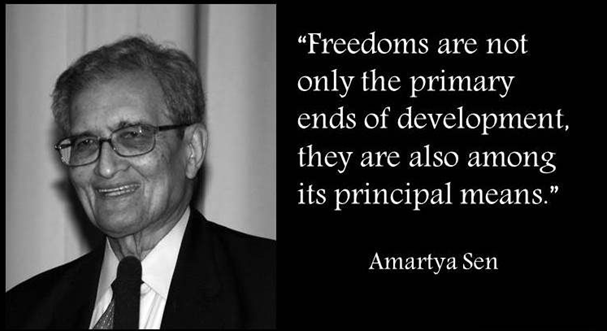
The Capability Approach was developed by the economist and philosopher Amartya Sen, winner of the 1998 Nobel Prize in economics. He views development as not the expansion of commodity production, but as about individuals’ opportunities and freedoms to functionings.
Functionings refer to the various ‘being’ or ‘doing’ that individuals can achieve. They represent the actual achievements of an individual, such as being well-nourished, educated, having shelter, being well-clothed, and participating in social and economic activities.
Capabilities represent a person’s freedom to achieve various functionings. They are the real opportunities or freedoms that people have to achieve the functionings they value.
For example, person having access to quality education and the freedom to attend school represents their capability. However, whether they achieve an educated state depends on their choices and circumstances.
Moreover, to him poverty cannot be properly measured by income and utility. It does not matter what commodities a person has, what matter is that what a person can or cannot do, can or cannot be with these commodities.
For example, a book is of little value to an illiterate person. Or, as Sen noted, a person with a parasitic disease will be less able to extract nourishment from a given quantity of food than someone without parasites.
Thus, looking at real income levels or even the levels of consumption of specific commodities cannot suffice as a measure of well-being. One may have a lot of commodities, but these are of little value if they are not what consumers desire.
Sen argues that one may have income, but certain commodities essential for well-being, such as nutritious foods, may be unavailable. He provides an excellent example of bread, the most basic of commodities. It has product “characteristics” such as taste and nutrition, such as protein.
But many of these benefits depend on the person and her circumstances, such as her activity level, metabolism, weight, whether she is pregnant or lactating, nutrition knowledge, whether she is infected with parasites, and her access to medical service.
For Sen, human “well-being” means being well, in the basic sense of being healthy, well-nourished, well-clothed, literate, and long-lived, and, more broadly, being able to take part in the life of the community, being mobile, being physically secure, and having freedom of choice in what one can become and can do.


 MinhajMetricsHub