

LQ.1. Explain the law of diminishing utility. Illustrate your answer with appropriate diagrams. Discuss also the assumptions and limitations of this law.
Law of Diminishing Marginal utility (Gossen’s First Law)
“The Law of Diminishing Marginal Utility states that as a consumer consumes more and more units of a good, then extra utility derives from an extra unit of the good goes on falling”. In other words, marginal utility of a good diminishes as an individual consumes more units of a good. Thus, the law of diminishing marginal utility means that the total utility increases at a decreasing rate. It is because intensity of want goes on to falling as more units of the same good are consumed.
Law of diminishing is explained in table 1 TU and MU Schedules.
| Quantity Consumed | Total Utility (TU) | Marginal Utility (MU) |
|---|---|---|
| 1 | 10 | 10 |
| 2 | 18 | 8 |
| 3 | 24 | 6 |
| 4 | 28 | 4 |
| 5 | 30 | 2 |
| 6 | 30 | 0 |
| 7 | 28 | -2 |
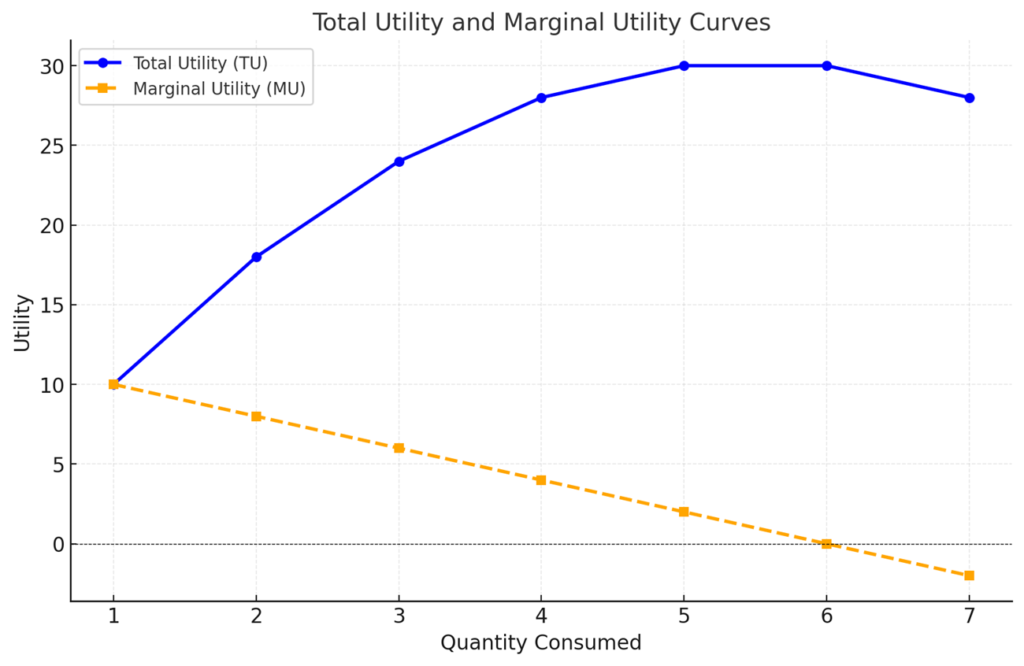
Figure 1 TU and MU Curves
Explanation
The law of diminishing Marginal utility can be explained with the help of a schedule and graph. In figure 1 we measure units of good X (sandwich) on horizontal axis and utility of good X (sandwich) on vertical axis. We can see that as a consumer consumes more units of good X, TU increases at a decreasing rate up to the 5th unit, TU is maximum at 5th unit and then TU decreases.
When TU is increasing MU remains positive, when TU is maximum and MU is zero, this is called saturation point. After saturation point TU decreases and MU becomes negative.
Assumptions of the Law
The law of diminishing MU holds only under certain given conditions. These conditions are often referred to as the assumptions of the law.
- Rational Behavior: Consumer`s aim is to maximize utility.
- Homogeneous Units: The goods consumed are identical.
- Continuity: Consumption occurs without time gaps.
- Constancy of Taste: Preferences remain unchanged.
- Utility is Measurable: Utility can be quantified.
Limitations of the Law
- Diverse Goods: It does not apply to non-homogeneous goods.
- Utility is not Measurable: Cardinal measurement of utility is not possible asa utility is a psychological phenomenon.
- Exceptional Cases: Collection and addiction may violate the law.
- Indivisible Units: Requires divisible goods for continuous consumption.
- Psychological Changes: Changes in mood or preference affect the law
Exceptions of the Law
Exceptions to the law of diminishing marginal utility refer to the things on which this law does hold true. These are:
- Knowledge: Utility may increase with more knowledge.
- Precious and Luxury goods: Items like diamonds or antiques may have increasing marginal utility.
- Love for Power: Marginal utility for gaining more power may not follow the law of DMU.
- Addictive Goods: Goods like alcohol, tobacco or drugs does not follow this law.






 MinhajMetricsHub