

Economic forecasting has always been one of the toughest jobs in economics — predicting inflation, growth, or job trends often felt like reading tea leaves. But today, artificial intelligence and machine learning are changing the game, helping economists see patterns in data that human eyes and old statistical models often miss.
Introduction
Artificial Intelligence (AI) and Machine Learning (ML) are changing the way economists study and predict the economy. For many years, economists used old statistical tools to guess what would happen to prices, jobs, and growth. Today, AI and ML are giving economists new and faster ways to understand economic data. This article explains, in simple words, what AI and ML are, how they are used in economic forecasting, and what challenges come with using them.
What is Artificial Intelligence (AI)?
Artificial Intelligence means teaching computers to do tasks that normally need human thinking. These tasks include learning, reasoning, solving problems, understanding language, and making decisions. In simple words, AI is when a computer does a job that usually needs a human brain. AI systems get better over time because they study large amounts of data using methods like machine learning and deep learning.
What is Machine Learning (ML)?
Machine Learning is a part of AI. Arthur Samuel, who built a famous computer program that played checkers, described machine learning as the ability of computers to learn from experience without being told exact instructions for every situation. ML helps computers study data, find patterns, and make predictions with very little help from humans. There are four main types of machine learning:

- Types of Machine Learning
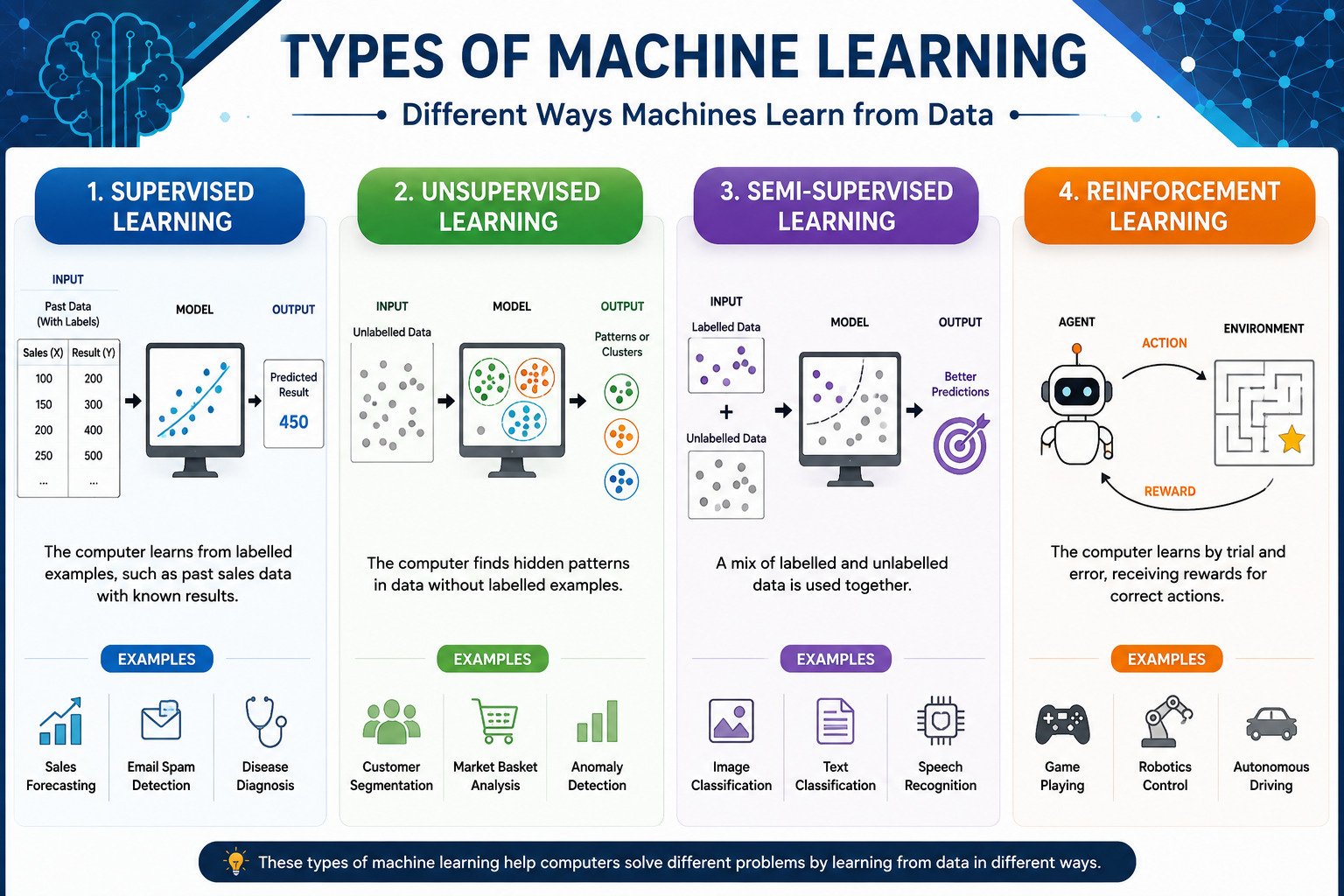
- Supervised Learning – the computer learns from labelled examples, such as past sales data with known results.
- Unsupervised Learning – the computer finds hidden patterns in data without labelled examples.
- Semi-Supervised Learning – a mix of labelled and unlabelled data is used together.
- Reinforcement Learning – the computer learns by trial and error, receiving rewards for correct actions.
What is Economic Forecasting?
Economic forecasting means predicting what will happen in the economy in the future. Economists look at old data, current trends, and social or political events to make these predictions. Good forecasts help governments and businesses make smart decisions about money, taxes, spending, and investment. There are three common ways to make economic forecasts:
- Traditional statistical forecasting
- Human intuition and expert judgement
- AI-driven forecasting
Traditional forecasting uses statistical and econometric models such as regression and time-series analysis. Human intuition relies on the experience and judgement of experts. AI-driven forecasting uses computer algorithms that learn from large amounts of data to make predictions.
Traditional Forecasting vs AI-Driven Forecasting
Traditional economic forecasting depends on econometric models such as AR (Autoregressive), MA (Moving Average), ARIMA, VAR (Vector Autoregression), ARDL, and VECM. These models use historical data on GDP, inflation, and unemployment, and they usually assume that relationships between variables are simple and straight-line (linear). They have worked well for many years, but they struggle when something unusual happens, such as a pandemic or a financial crash, because these events break the normal patterns the models expect.
AI-driven forecasting, on the other hand, uses machine learning algorithms and big data to study historical information and predict outcomes like GDP growth, inflation, and market trends. These models can automatically find patterns in large sets of data without needing a fixed formula. They can also update themselves as new data arrives, which makes them more flexible during fast-changing situations. Many researchers now suggest using a hybrid approach — combining traditional economic theory with machine learning tools — to get the best of both worlds.
Comparison Table: Traditional Models vs Machine Learning Models
| Criteria | Traditional Models | Machine Learning Models |
|---|---|---|
| Data Sources | Rely on structured data such as official statistics and surveys. | Can use unstructured data too, such as news articles, social media, and satellite images. |
| Pattern Detection | Assumes simple, straight-line relationships based on economic theory. | Finds hidden and complex, non-linear patterns on its own. |
| Adaptability | Updated occasionally; struggles during sudden shocks. | Learns in real time and adapts quickly to new conditions. |
| Interpretability | Clear and explainable with visible equations. | Often a “black box”; harder to explain without special tools. |
| Accuracy | Works well in stable, predictable conditions. | More accurate during volatile or complex periods. |
| Human Input | Needs economists to choose variables based on theory. | Learns relationships mostly from data, with human checks for quality. |
| Speed of Forecasts | Usually updated monthly or quarterly. | Can offer near real-time updates. |
How AI is Used in Economics and Finance
AI is now used across almost every part of the economy. Below are some of the main areas.
1. Central Banks and Policy Making
Central banks and policy institutions use AI to predict important indicators such as GDP growth, inflation, and unemployment. This helps them make better decisions about interest rates and monetary policy. AI models can also warn policymakers about turning points, such as rising inflation or an approaching recession, earlier than older models could. A growing practice called “nowcasting” uses AI to estimate current economic conditions in real time, even before official statistics are released, by studying data such as electricity usage, card transactions, and search engine trends.
2. Labour Market
Many people worry that AI will take away jobs. However, a more accurate way to think about it is that “AI will not replace people, but people who use AI will replace those who don’t.” This shows how important it is to learn and adapt to new technology. AI has also created brand new careers, such as data scientists, AI specialists, and cybersecurity experts, which did not exist a few years ago.
3. Financial Markets
Investment firms use AI to study stock prices, market trends, and volatility. These predictions guide trading decisions and help firms build stronger investment portfolios. AI systems can study years of price history, news reports, and social media posts to guess how stock prices might move next.
4. Business Forecasting
Companies use AI to forecast product demand, revenue, and other business numbers. This helps them plan production, manage stock, and reduce waste.
5. Manufacturing and Industry
AI-powered robots and machines are used in factories to keep product quality steady, work faster, and reduce human error. This lowers the cost of making each product and increases overall productivity.
6. Banking and Fraud Detection
Banks use AI to spot unusual activity and predict the chance of fraud. AI systems can flag suspicious transactions much faster than manual checks, which helps protect both banks and customers.
AI in Econometrics and Economic Analysis
AI is not replacing economic theory — it is making it stronger. Here is how:
- Improving Predictive Power: Economists can combine traditional models, such as Vector Autoregression (VAR), with machine learning to choose the best variables and capture complex patterns.
- Causal Analysis: Methods like double machine learning allow economists to study cause-and-effect relationships while letting AI handle many background factors at once.
- Automating Model Selection: Instead of testing variables one by one by hand, AI can quickly scan hundreds of possible predictors and choose the ones that actually improve accuracy.
In short, econometric models bring theory and clear explanations, while AI brings flexibility and stronger prediction power. Most researchers now see AI as a partner to traditional economics, not a replacement for it.
Popular AI and ML Techniques Used in Economic Forecasting
- AI and ML Techniques Used in Economic Forecasting
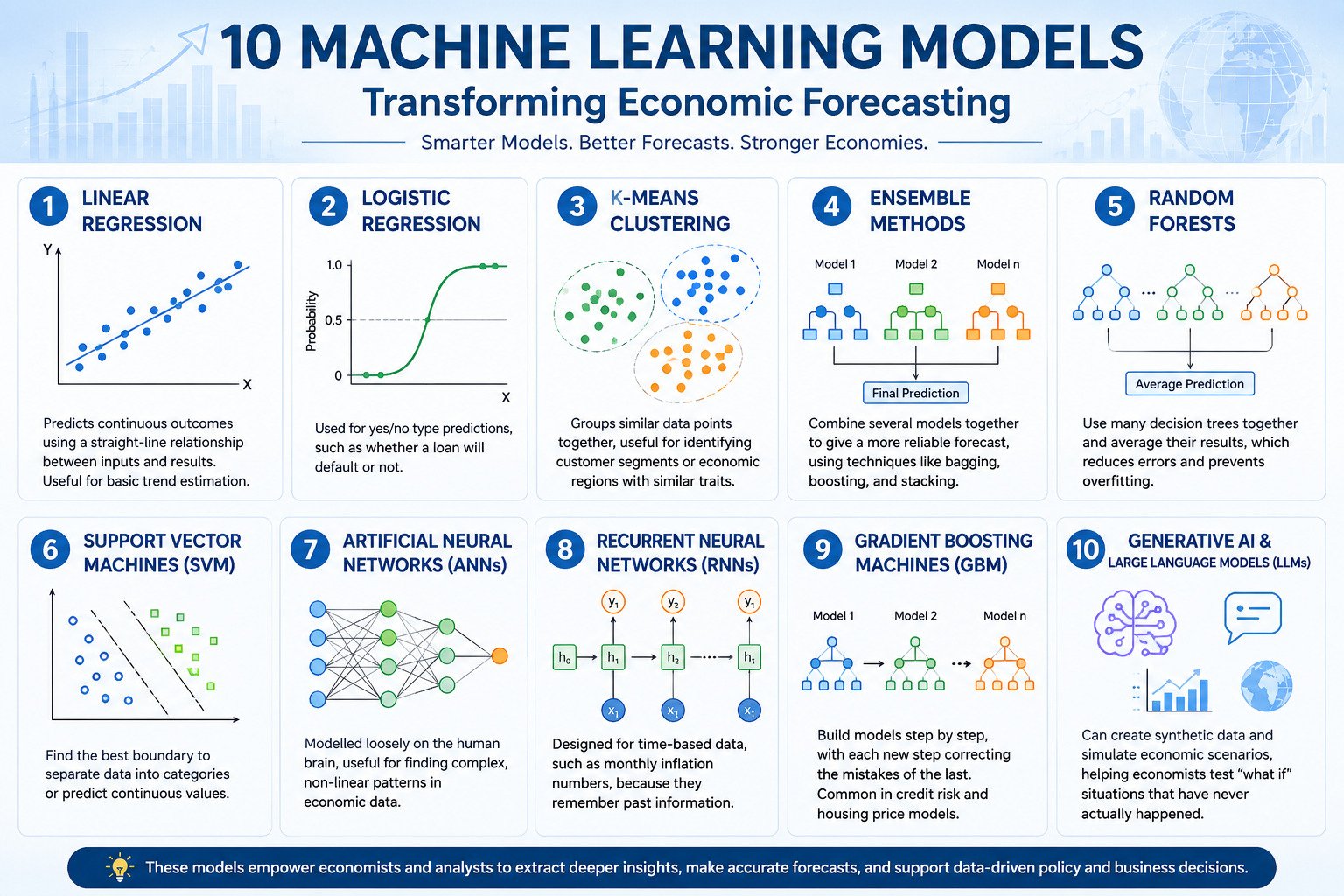
- Linear Regression – predicts continuous outcomes using a straight-line relationship between inputs and results. Useful for basic trend estimation.
- Logistic Regression – used for yes/no type predictions, such as whether a loan will default or not.
- K-Means Clustering – groups similar data points together, useful for identifying customer segments or economic regions with similar traits.
- Ensemble Methods – combine several models together to give a more reliable forecast, using techniques like bagging, boosting, and stacking.
- Random Forests – use many decision trees together and average their results, which reduces errors and prevents overfitting.
- Support Vector Machines (SVM) – find the best boundary to separate data into categories or predict continuous values.
- Artificial Neural Networks (ANNs) – modelled loosely on the human brain, useful for finding complex, non-linear patterns in economic data.
- Recurrent Neural Networks (RNNs) – designed for time-based data, such as monthly inflation numbers, because they remember past information.
- Gradient Boosting Machines (GBM) – build models step by step, with each new step correcting the mistakes of the last. Common in credit risk and housing price models.
- Generative AI and Large Language Models (LLMs) – can create synthetic data and simulate economic scenarios, helping economists test “what if” situations that have never actually happened.
Real-World Examples
Several major institutions already use AI in their daily work:
- Central banks such as the US Federal Reserve and the Bank of England have experimented with AI tools to study economic reports, speeches, and news text, helping them judge market sentiment and economic mood.
- The International Monetary Fund (IMF) has explored AI-based nowcasting models to track economic activity in countries where official data is slow or limited.
- Large investment banks and asset managers use machine learning models to analyse huge volumes of financial data and alternative data sources, such as satellite images of parking lots or shipping activity, to predict company performance before official reports are released.
- Credit rating agencies and fintech companies use AI to assess loan risk and detect fraud in real time.
Limitations and Challenges of Using AI in Economic Forecasting
Even though AI offers many benefits, it also comes with real challenges:
- Black Box Problem: AI and ML models are often hard to explain, unlike traditional models where every equation and number can be understood clearly. This lack of transparency is being addressed by a growing field called Explainable AI (XAI).
- Cybersecurity Risks: As AI use grows in finance, so does the risk of cyberattacks, which can lead to wrong decisions if systems are not carefully monitored.
- Overfitting: AI models can become too focused on old data patterns, which makes them perform poorly when faced with new, unseen situations.
- Global Inequality: Countries with strong AI capability can grow faster, attract more investment, and shape global trade rules, which may widen the gap between developed and developing nations.
- Skills Gap: Many countries lack the coding, data science, and technical skills needed to use AI effectively in banking, finance, and government. Building these skills takes time and money, which is especially hard for developing economies.
- Data Quality and Bias: AI models are only as good as the data they are trained on. Poor quality or biased data can lead to unfair or incorrect predictions, which is a growing concern for regulators worldwide.
The Future of AI in Economics
Looking ahead, AI is expected to play an even bigger role in economic forecasting. Hybrid models that combine traditional economic theory with machine learning are likely to become the standard approach. Explainable AI tools will help make “black box” models easier to trust and use in policy decisions. Governments and regulators are also expected to build clearer rules around how AI can be used in finance and economic policy, to protect against risks like bias, cyberattacks, and unfair outcomes. As more countries build AI skills and infrastructure, the benefits of AI-driven forecasting may spread more evenly across the world.
Conclusion
AI and Machine Learning are reshaping economic forecasting by making predictions faster, more flexible, and often more accurate than older statistical methods alone. However, traditional econometric models still matter because they offer clear explanations and are grounded in economic theory. The best path forward is a hybrid approach, where AI handles complex pattern-finding and economists provide the theory, judgement, and interpretation that AI alone cannot offer. As AI tools continue to improve, and as more countries build the skills to use them, AI is likely to become a permanent and valuable partner in economic analysis and policymaking.
Suggestions for further readings
- Artificial Intelligence in Economics | AI Blog | NCU
- The Role of AI in Forecasting Economic Trends | HackerNoon
- Artificial Intelligence in Economic Forecasting and Analysis – maseconomics


 MinhajMetricsHub